

Keeping food cool on public transport takes more than choosing a bag. A delayed train, a hot walk to the stop or a crowded carriage can all add time before lunch reaches the fridge. For potentially hazardous food, the Australian temperature danger zone is between 5°C and 60°C, so planning how you pack and carry it matters.
A bulky cooler may not suit a commute, and there may be nowhere to chill food along the way. Match your cooling setup to the food, journey time and conditions, then plan what you’ll do if your trip takes longer than expected.
This guide covers how to prepare and pack chilled food, compare practical cooling options such as a Coolpod Freezable Lunch Bag with integrated cooling, and apply the 2-hour/4-hour food safety rule if food warms up. You’ll also find tips for longer journeys, hot weather and carrying food on public transport.
Key Takeaways
- Plan for the entire trip, including walks, transfers and waiting time, so you can keep food cold from home until you’re ready to eat.
- Choose food and portion sizes that suit your commute, and pack them in secure, leak-resistant containers that fit your cooling bag.
- Compare an insulated lunch bag, separate ice packs and a freezable bag based on the space you have and the journey you make.
- Build a simple routine for chilling, packing and storing food, and follow your bag’s preparation and care instructions.
- Keeping food cool on public transport is easier when your cooling method fits the meal. Coolpod’s Australian-owned patented freezable bags are one option, with integrated cooling and no need for separate ice packs.
Keeping food cool on public transport starts with understanding the journey
The cold chain is the effort to keep chilled food cool from the moment you pack it until you’re ready to eat it. For a commuter, that means counting more than the time spent on a bus or train. Your food is travelling while you walk to the stop, wait on the platform, change services and deal with delays.
A cooling bag helps manage temperature, but it can’t prove that food has stayed safely chilled. Food safety also depends on starting with properly chilled food, limiting exposure to warm conditions and making sensible decisions if your trip takes longer than expected. These are practical applications of broader Food Safety Principles, including temperature control and preventing contamination.
Which parts of a public transport trip can warm food?
Count the whole journey, not just the scheduled ride. A walk in the sun, a wait on a warm platform, a missed connection or a slow trip home can all add time outside refrigeration. Sunlight through a station window or a hot waiting area can also warm food, particularly if it is exposed.
Keep chilled food enclosed and avoid opening the bag repeatedly to check or retrieve items. If you’ll eat a snack earlier, pack it where you can reach it without leaving the rest of the food exposed for long. During a transfer or delay, keep the bag in the shade where practical and out of direct sunlight.
What does food-safety guidance mean for commuters?
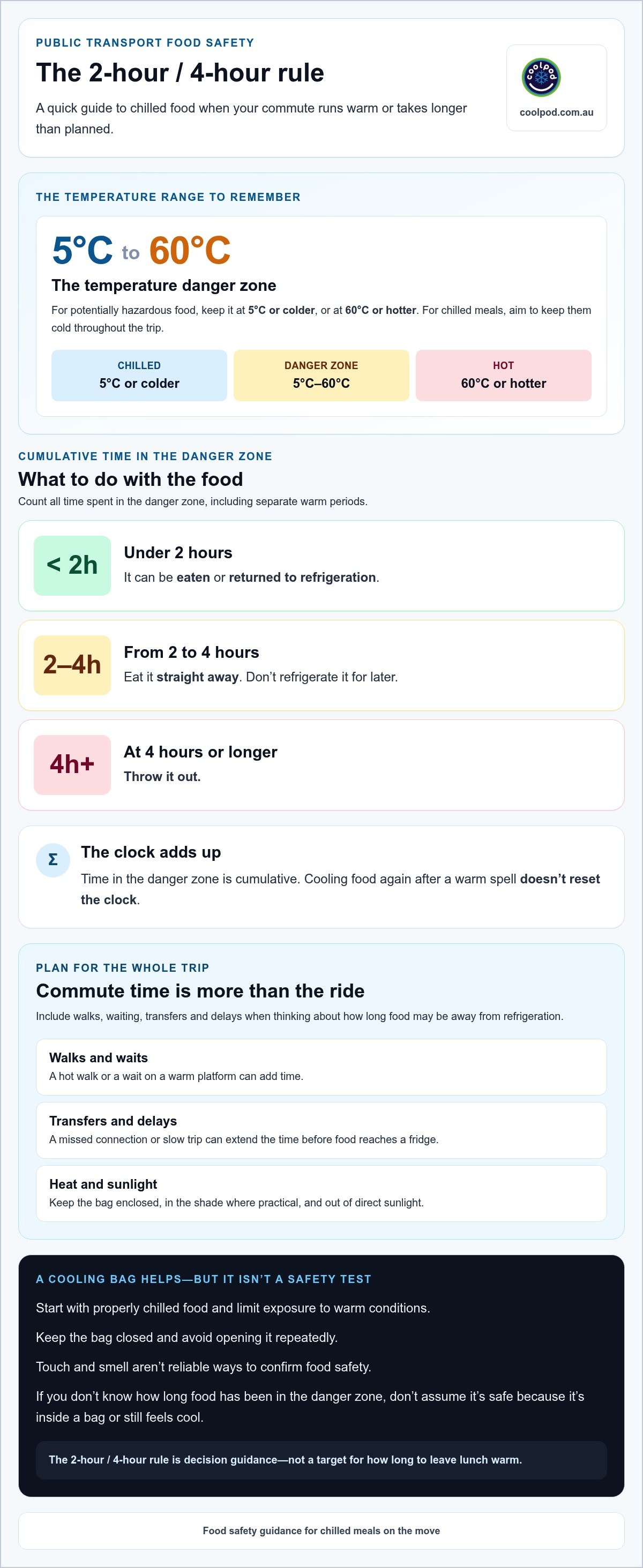
Food Standards Australia New Zealand (FSANZ) identifies 5°C to 60°C as the temperature danger zone for potentially hazardous food. Keep this food at 5°C or colder, or at 60°C or hotter, to limit the growth of food-poisoning bacteria. For chilled meals, the practical aim is to keep them cold throughout the trip.
FSANZ’s 2-hour/4-hour rule applies to the cumulative time potentially hazardous food spends in the danger zone. Under two hours, it can be eaten or returned to refrigeration. From two to four hours, eat it straight away and don’t refrigerate it for later. At four hours or longer, throw it out. Time adds up across separate periods, so cooling food again after a warm spell doesn’t reset the clock.
These timings are decision guidance, not a target for how long to leave lunch warm. If you don’t know how long food has been in the danger zone, don’t assume it’s safe because it’s inside a bag or still feels cool. Touch and smell aren’t reliable ways to confirm food safety.
When keeping food cool on public transport, plan for the likely journey and conditions, then allow for the unexpected. A cooling setup can help reduce warming, but it can’t undo food that was packed warm or replace safe handling. If your commute changes, keep the food closed and out of heat, account for the total time without temperature control, and decide whether it’s still suitable to eat.
Choose food and packing formats that suit your public transport commute
A practical commute lunch is easy to carry, easy to reach and packed to suit the food. Start by deciding what needs to stay chilled, what you’ll eat soon after leaving home and what can travel without cooling. This helps you avoid taking unnecessary items or squeezing a meal into a container that doesn’t travel well.
Yoghurt, cut fruit and prepared meals are familiar choices to pack chilled. Other foods, such as whole fruit or crackers, may be easier to carry separately if they don’t need refrigeration. Check storage instructions on packaged food, and keep chilled items apart from food that doesn’t need cooling. Separating them also makes it easier to find what you want without unpacking everything.
Which foods are practical to carry chilled?
Choose chilled foods that are easy to portion and seal. A prepared meal in a close-fitting container or yoghurt in its original packaging can be straightforward to pack. Juicy cut fruit needs a leak-resistant container. Consider whether food will stay upright in your bag, and seal items that could leak or crush other food separately.
- Chilled items: Pack yoghurt, cut fruit or a prepared meal so each portion is contained.
- Foods that don’t need cooling: Carry items such as whole fruit or crackers separately, so they don’t take up room in the cooling bag.
- Packaged foods: Follow the storage instructions on the label, including any direction to refrigerate after opening.
How can you make a packed meal easier to carry?
Choose containers that close securely and fit inside the cooling bag without forcing it open. A poor fit makes packing awkward and leaves less room for chilled food. Keep portions manageable, especially if you’ll be standing, changing services or carrying other bags. Put utensils and napkins in a separate pocket or pouch so you can reach them without rummaging among the food.
Think about the order you’ll eat things, too. Place the item you’ll need first somewhere accessible, while keeping the chilled food enclosed as much as possible. If you’re carrying chilled and shelf-stable food, use separate sections or bags. You can then take out a snack that doesn’t need cooling without disturbing the rest of your meal.
For keeping food cool on public transport, choose a format that suits your food and route rather than simply carrying the largest container available. If you’re comparing ways to carry lunch, this freezable lunch bag guide can help you think through what suits your routine. For a lunch-focused option, explore Coolpod freezable lunch bags as part of your packing plan.
Compare cooling setups for different public transport trips
The right setup depends on what you’re carrying, how long you expect to travel and how much room you have. An insulated lunch bag gives you a way to carry food, but it doesn’t cool food by itself. Separate ice packs or a freezable bag add cooling, with different preparation and packing requirements.
Use this comparison as a starting point. Cooling results depend on the food, surrounding conditions, preparation and product instructions. No bag can guarantee a food temperature throughout every commute.
| Setup | Preparation | Extra items | Flexibility and trip fit |
|---|---|---|---|
| Insulated lunch bag | Pack food into the bag; it doesn’t cool food on its own. | Cooling may require separate ice packs or another suitable cooling method. | A straightforward carry option for short trips when paired with an appropriate cooling method for the food and journey. |
| Separate ice packs | Freeze the packs ahead of time and position them with the food as directed. | Each pack takes up space and needs to be carried. | You can adjust the number and arrangement to suit the bag’s capacity, but allow room for both food and packs. |
| Freezable bag | Prepare the bag according to its instructions before packing. | Coolpod freezable bags use integrated cooling technology, so separate ice packs aren’t needed. | A practical option if you want cooling built into the food-carrying setup; choose a size and format suited to your meal. |
When might an insulated bag or separate ice packs suit?
An insulated bag can organise and carry lunch, but insulation alone isn’t active cooling. Separate ice packs may suit a bag you already use or a meal that needs a particular packing arrangement. Freeze them in advance and account for the space they take up alongside the food and container. Make sure the packed setup fits comfortably without forcing the bag closed.
When could a freezable bag be a convenient option?
A freezable bag combines food carrying with integrated cooling technology. Coolpod bags are designed to keep contents cold for hours without separate ice packs, which can simplify packing if you’d rather not carry extra cooling items. Follow the specific bag’s preparation and care instructions, and consider the food, journey length and conditions when choosing it.
For a bento-style meal, the right shape and space for food containers can make packing easier. This bento cooler bag guide offers a closer look at that format.
Match the cooling setup to the journey, meal and available space instead of looking for one option that suits every commute. This is a practical way to approach keeping food cool on public transport, especially when travel times or conditions vary.
Follow a simple routine to pack and carry chilled food
A repeatable routine makes lunch easier to manage, even when the morning is busy or the commute changes. Start with food that has been chilled and handled according to its label or safe-storage guidance. Prepare your cooling bag as directed, pack it securely and decide where you’ll put the food when you arrive.
What should you do before leaving home?
Set up your bag before packing so food isn’t left on the bench while you organise everything else. Follow the manufacturer’s preparation and care instructions for your cooling bag. Pack chilled items in secure containers, close the bag and keep it closed until you’re ready to eat or store the food.
- Chill the food. Store food according to its label or safe-handling guidance before packing. Don’t rely on the bag to chill food that has been left out.
- Prepare the cooling setup. Follow the manufacturer’s instructions for getting your bag ready. If you use separate cooling items, prepare those as directed, too.
- Seal each portion. Use containers that close securely, especially for liquids or cut fruit. Arrange them so they won’t tip or get crushed during the trip.
- Pack and close the bag. Put chilled food inside, then close the bag before you leave. Keep utensils and other items you may need accessible without repeatedly opening it.
- Carry it thoughtfully. Keep the bag out of direct sun and away from hot spots while walking, waiting or changing services. Avoid leaving it unattended in a hot location.
- Store food on arrival. If the food needs refrigeration, put it in the fridge promptly. Otherwise, follow its storage instructions and make a food-safety decision based on the journey and time outside temperature control.
How should you manage transfers, delays and arrival?
Keep the bag closed and shaded during a wait or transfer, and don’t leave it in a hot vehicle or sunlit area. If your trip runs late, account for the extra time rather than assuming the bag guarantees the food is still safe. At work, school or your destination, refrigerate food that needs chilling as soon as practical, or follow its storage directions.
Quick check: chill the food, prepare the bag, seal the portions, keep the bag shaded and closed, then store the food appropriately on arrival. This simple sequence supports keeping food cool on public transport without treating a cooling bag as a substitute for safe handling.
For a commute-friendly option with integrated cooling, explore Coolpod freezable bags for lunch and follow the preparation instructions for your chosen bag.
Make a Coolpod freezable bag part of your commute plan
A freezable bag can fit into the routine you’ve already built: choose a format that suits your meal, prepare it according to its instructions, pack properly chilled food and carry it closed and out of direct sun. It’s one part of a commute plan, not a replacement for safe food handling or good judgement if your journey changes.
Coolpod is an Australian-owned specialist in patented freezable bags for lunches, bento meals, yoghurt and drinks. Its bags use integrated cooling technology and are designed to keep contents cold for hours without separate ice packs. That can simplify packing if you’d rather not freeze, pack and carry an extra cooling item. Results still depend on factors such as the food, preparation, journey and surrounding conditions.
What makes an integrated cooling bag relevant to commuters?
When a commute includes a walk, a service change or limited room in your work bag, combining food carrying and cooling in one bag can make packing more straightforward. The Coolpod Freezable Lunch Bag is one option for carrying a meal. Prepare and care for it as directed, and pack food securely. A freezable bag supports your cooling plan, but doesn’t establish that food has stayed at a safe temperature.
How can you decide if this approach suits your routine?
Start with the meal: consider its portion size, container shape and whether it needs to stay chilled. Then think about your usual journey, available bag space and whether preparing a freezable bag ahead of time fits your mornings. If your trip often includes delays or long waits in warm conditions, plan for those rather than relying on the bag alone.
A quick way to assess the fit is to consider:
- The meal: Does the bag suit the portion and container you normally carry?
- The commute: Can you carry it comfortably through walks, transfers and busy services?
- The routine: Can you prepare and care for the bag as its instructions recommend?
If the format suits your food and daily travel, explore Coolpod’s freezable bags for meals, bento, yoghurt and drinks. Choose a bag that fits your routine, then pair it with sensible packing and food-safety decisions for the journey ahead.
Make your next commute easier to plan
Make a packing routine that fits your actual travel day. Think about the meal you want to carry, how much space you have and whether your usual route includes long waits or transfers. A practical setup should be easy to prepare before you leave and simple to manage on the way.
If integrated cooling suits that routine, Coolpod’s Australian-owned range offers patented freezable bags designed to keep contents cold for hours without separate ice packs. Choose a format that fits your food and follow its preparation and care instructions. It’s one option for keeping food cool on public transport, alongside sensible food handling and decisions that reflect your journey’s conditions.
Explore Coolpod’s freezable bags and find a format that could make carrying lunch more straightforward. With a setup that works for your commute, you can head out feeling more prepared for the day.
Frequently Asked Questions
Can I use a frozen water bottle instead of an ice pack?
Yes, a frozen, sealed water bottle can act as a cooling aid alongside chilled food. Place it in the bag near the food, and keep it upright if possible to reduce the chance of leaks as it thaws. Make sure the bottle is suitable for freezing and leave room for the contents to expand. It won’t guarantee a particular food temperature, so consider your travel time and conditions too.
Are ice packs allowed on public transport in Australia?
There isn’t one simple rule that covers every Australian public transport service. If you’re carrying ice packs with a personal lunch, pack them securely and prevent leaks, and follow the conditions for your service. Rules about eating and drinking vary across networks, so check the relevant transport operator’s passenger information if you’re unsure. This is especially useful if you’re travelling with a large cooler or taking food on a regional service.
Should I freeze a sandwich before taking it on public transport?
Usually, you don’t need to freeze a sandwich just to carry it. Freezing can change the texture of fillings such as salad, tomato or mayonnaise, and a frozen centre may still be thawing when you want to eat. Instead, prepare it with chilled ingredients, wrap or contain it securely, and carry it in a suitable cooling setup. If you do freeze a sandwich, choose fillings that freeze well and allow time for safe thawing.
Can I carry hot and cold food in the same bag?
It’s better to carry them separately. A hot container can warm nearby chilled food, making it harder to keep that food cold during the trip. Use separate bags or well-sealed containers designed for the different temperatures, and avoid placing hot food beside chilled items in one compartment. If you can’t separate them, prioritise keeping potentially hazardous chilled food cold and plan to eat hot food soon after leaving home.
Can cut fruit be carried with a chilled lunch?
Yes. Pack cut fruit in a clean, sealed container so juice doesn’t leak onto other food, and keep it with the chilled items if it needs refrigeration. Whole fruit can travel separately if it doesn’t need chilling. For easier handling on a crowded commute, portion fruit before leaving and use a container that won’t squash easily. Follow any storage advice on packaged fruit, particularly once it has been opened.
What should I do if my lunch bag feels warm when I arrive?
A warm bag doesn’t tell you exactly how warm the food became, so don’t use touch alone to judge whether it’s safe. Consider how long the food may have spent between 5°C and 60°C, adding together any time during the journey and after arrival. FSANZ’s 2-hour/4-hour rule can guide your decision. If you can’t work out the exposure time or have doubts about safety, the cautious choice is to discard it.
How should I carry chilled groceries on public transport?
Group chilled groceries together in a secure insulated or freezable bag, separate from heavy items that could crush packaging. Do your chilled shopping towards the end of your errands, then travel directly home where practical. Keep groceries shaded and avoid leaving them unattended somewhere hot, such as a parked car. Once home, unpack promptly and refrigerate items according to their labels. For longer trips, plan the route and cooling setup before shopping.
For a commute-ready cooling option, explore Coolpod’s freezable bags and choose a format that suits the food you carry.


