

Imagine it's midday on a scorching 38-degree afternoon, you're finally ready for a break, but your sandwich feels like it's been sitting on a car dashboard. It's a common frustration for many Aussies, whether you're working on a dusty job site or commuting to a city office in the humidity. Choosing a high-quality insulated lunch bag is about more than just convenience; it's a vital step in keeping your tucker out of the temperature danger zone where harmful bacteria thrive. Standard bags often fail because they rely on passive insulation that simply can't compete with the intensity of our local climate.
We understand that nobody wants to deal with lukewarm meals, soggy containers from melting ice, or bulky packs that take up all your storage room. This guide will show you how to select a cooling solution that keeps your food fridge-cold for hours without the mess or the extra weight. We'll explore the latest 2026 food safety standards, the benefits of integrated freezable technology, and how to pick a durable design that survives the daily grind. By the end, you'll know exactly how to keep your lunch fresh, safe, and ready to enjoy, no matter how high the mercury rises.
Key Takeaways
- Learn why standard insulation isn't enough for the Aussie heat and how to keep your meals safely below the 5°C "danger zone" for hours.
- Understand the mechanics of a high-performance insulated lunch bag and why integrated freezable technology is replacing bulky, leaking ice packs in 2026.
- Discover the "set and forget" convenience of patented cooling liners that eliminate condensation and save valuable space in your bag.
- Get expert tips on selecting the right size and style for your lifestyle, whether you need a rugged kit for the job site or a slimline pouch for yoghurt and snacks.
- Explore why Australian-designed solutions offer superior durability and performance when facing our unique environmental challenges.
The Reality of the Aussie Lunch: Why Standard Insulation Often Fails
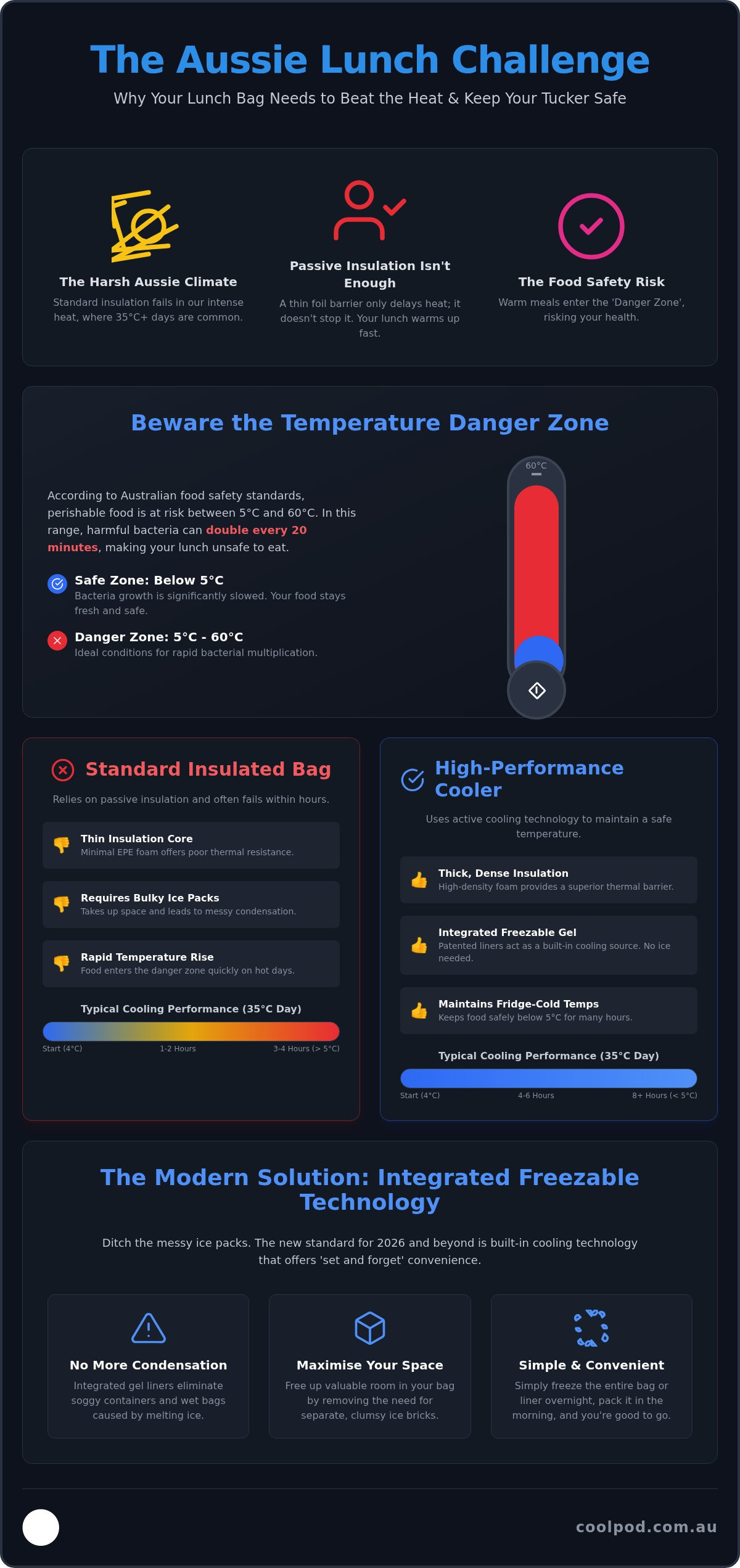
Most of us have been there. It's midday, the sun is beating down, and you're finally ready for that ham and salad roll you packed this morning. You open your bag only to find the meat is lukewarm and the lettuce has wilted into a sad, transparent mess. In the Australian summer, 35 degrees in the shade is a standard Tuesday, yet many people still rely on basic gear to protect their meals. A standard insulated lunch bag bought off a supermarket shelf is often little more than a thin foil barrier. It's designed to slow down heat, not stop it, and in our climate, "slowing down" simply isn't enough to keep your tucker fresh until the break bell rings.
Passive insulation is essentially a delay tactic. It works by creating a pocket of air that resists the outside temperature, but it eventually succumbs to the laws of physics. Without a dedicated cooling source, the inside of a cheap bag will equalise with the outside temperature much faster than you'd expect. This is why your lunch bag needs to do more than just block the heat; it needs to actively fight it with a reliable thermal barrier.
The Science of Heat Transfer in Australia
Radiant heat is particularly aggressive in the Southern Hemisphere. It penetrates standard lunch boxes throughout the morning, especially if they're stored in a backpack, a locker, or a vehicle. Every time you open the zip to grab a snack, you let out the precious cool air and invite in a rush of warm humidity. Understanding how insulated bags work helps illustrate why most supermarket options fall short. They typically rely on a thin layer of EPE foam that is easily overwhelmed by high ambient temperatures. A truly effective solution requires a dense thermal core that can absorb that incoming energy before it reaches your food.
Food Safety: Avoiding the Midday Disaster
Food safety is a non-negotiable part of the daily routine for professionals and parents alike. According to Australian food safety guidelines, perishable items like dairy, chicken, and mayo-based salads must stay out of the "danger zone", which is between 5°C and 60°C. In a warm environment, bacteria levels can double every 20 minutes. If your lunch sits in that zone from the morning commute until noon, you're looking at a significant health risk. High-performance cooling isn't just about a better-tasting sandwich; it's about the peace of mind that comes from knowing your meal is safe. Investing in a smarter insulated lunch bag ensures that your food stays fridge-cold, regardless of how high the mercury rises on the job site.
How Does an Insulated Lunch Bag Actually Work?
At its simplest, an insulated lunch bag acts as a portable thermal barrier. It's designed to resist the flow of heat, keeping your chilled items cold and your warm items from losing their temperature too quickly. While it might look like a standard bag on the outside, the magic happens within its walls. Most high-quality bags are engineered with a specific three-layer system that works together to fight off the harsh Australian sun. Adhering to food safety recommendations is much easier when you understand how these layers function to protect your tucker.
The Three Layers of Protection
The first line of defence is the outer shell. This is typically made from heavy-duty polyester or nylon, chosen for its ability to survive the daily commute or the rigours of a job site. It provides the structural integrity needed to protect your containers from being squashed. Behind this shell lies the core insulation layer, usually consisting of expanded polyethylene (EPE) foam. This foam is filled with tiny air bubbles that trap air; because air is a poor conductor of heat, it slows down the transfer of energy from the outside world into your bag. Finally, the inner lining, often made of PEVA or aluminium, provides a reflective surface that bounces heat away while being waterproof and easy to wipe clean after a spill.
When you're shopping for gear, thickness is your best friend. A thin, flimsy bag won't have enough foam to provide a significant thermal break. High-density foam is the key indicator of a bag's quality; the denser and thicker the core, the longer your food will stay at a safe temperature.
Passive vs. Active Cooling
There are two ways to think about keeping things cold: passive and active systems. Passive cooling relies entirely on the bag's ability to trap the existing cold air from your fridge-cold containers. This works fine for a quick trip, but it's rarely enough for a full day in an Aussie summer. Active cooling, on the other hand, involves introducing a cooling source, such as a gel pack or a frozen drink, into the environment.
For most Australians, a hybrid approach is the only way to ensure maximum freshness. You need a bag that provides excellent passive insulation while incorporating an active cooling element to combat the 30-degree days. If you're tired of warm leftovers by noon, exploring innovative cooling designs that combine these two methods can make all the difference to your daily routine.
Ditching the Ice Pack: The Rise of Integrated Freezable Technology
For years, the standard way to boost an insulated lunch bag was to toss in a frozen brick or a gel pack. While effective for a short time, these loose packs come with a host of frustrations. They're bulky, they take up valuable room meant for your food, and they're heavy enough to crush a delicate wrap or fruit. Perhaps most annoying is the "sweating" effect. As the ice pack thaws, condensation builds up, leaving the bottom of your bag damp and your lunch unpleasantly soggy. It's a daily inconvenience that many of us have simply accepted as part of the routine.
Integrated freezable technology, like the patented system used in the Coolpod Freezable Lunch Bag, solves these issues by making the cooling source part of the bag itself. Instead of finding room for a separate brick, the walls of the bag contain a specialised cooling gel. You simply place the whole bag in the freezer overnight. By morning, you have a self-cooling environment that provides 360-degree protection for your tucker. This "set and forget" method is a game-changer for busy families and professionals who want one less thing to organise during the morning rush.
Freezable Bags vs. Traditional Ice Bags
The most immediate benefit of an integrated system is space efficiency. If you're using a compact insulated lunch bag, a traditional ice pack can occupy nearly a third of the internal volume. By moving the cooling gel into the lining, you reclaim that space for extra snacks or a larger water bottle. Weight distribution is another major factor. Loose ice packs tend to slide around, often ending up on top of your sandwiches and squashing them. Integrated panels stay perfectly in place, maintaining the bag's structure and protecting your meal's integrity. Because the cooling is built into every wall, the contents stay chilled more evenly than with a single loose pack that only cools the items directly touching it.
The Patented Advantage
Choosing Your Ideal Insulated Bag: From the Office to the Job Site
Finding the right insulated lunch bag is about matching the gear to your specific environment. A sleek pouch for a yoghurt snack in an air-conditioned office has vastly different requirements than a heavy-duty kit sitting in a hot ute all morning. Evaluating your needs starts with capacity. Are you packing a single sandwich, or do you need a full-sized kit capable of holding high-calorie meals and multiple drinks? Choosing the wrong size often leads to "dead air" inside the bag, which can reduce thermal efficiency, so it's vital to pick a bag that fits your daily tucker snugly.
Organisation is the next pillar of a good choice. The Coolpod Freezable Bento Bag is a prime example of clever engineering, allowing you to keep different food groups separate without sacrificing the cooling power of the integrated gel walls. For those with more specific requirements, specialised designs like the Coolpod Freezable Yoghurt Bag or the Coolpod Freezable Wine Cooler provide tailored protection. These options ensure that everything from a child's snack to a Friday afternoon bottle stays at the perfect temperature, regardless of the external conditions.
The Professional Choice: Style Meets Performance
In a corporate setting, you want gear that looks professional while performing at a high level. Modern office-bound designs move away from the "daggy" school lunch box aesthetic, opting for slim profiles and sophisticated colours. A critical feature for the daily commute is a leak-proof lining; nobody wants a stray spill ruining a laptop or important documents in their work bag. Look for designs that include dedicated internal pockets. These are perfect for keeping your cutlery, napkins, and dry snacks organised and away from the chilled main meal, ensuring your crackers stay crisp and your salad stays cold.
The Tradie Choice: Toughness in the Ute
On the job site, durability is the top priority. A lunch kit needs to withstand dust, vibration, and the intense radiant heat that builds up inside a vehicle. High-quality zips and reinforced handles are non-negotiable for longevity. Because tradies often face demanding physical work, the bag must accommodate larger containers and extra hydration. We prioritise easy-clean surfaces for these environments; a quick wipe down at the end of a shift should be all it takes to remove grease or site dust. When your gear is as tough as your tools, you don't have to worry about a midday meal disaster.
If you're ready to upgrade your daily carry with a solution built for the Australian climate, you can shop our full range of professional and job-site-ready cooling solutions to find your perfect match.
The Coolpod Solution: Smarter Cooling for Every Australian
Since 2010, we've focused on one thing: defeating the Aussie heat. As a homegrown, Australian-owned business, we understand that a standard insulated lunch bag often struggles when the mercury climbs towards forty degrees. Our patented technology was born from a need for something more reliable than passive foam and more convenient than loose ice bricks. By integrating the cooling power directly into the walls of the bag, we provide a solution that is both space-efficient and incredibly effective at maintaining food safety. This isn't just a bag; it's a piece of clever engineering designed specifically for our unique climate and lifestyle.
Choosing a local brand means you're getting gear that has been tested in the conditions you actually face. Whether you're working in a humid coastal city or a dry outback town, our bags are built to perform. We prioritise durable, high-quality materials that can withstand the rigours of the daily commute or a dusty job site. This commitment to longevity ensures that your investment continues to protect your tucker season after season, reducing waste and providing the peace of mind that only a dependable specialist can offer.
The Coolpod Product Range
Maintenance and Care for Your Bag
Longevity is built into our designs, but a little care goes a long way in keeping your gear at peak performance. For maximum cooling duration, ensure your bag is completely flat when you pop it in the freezer overnight. This guarantees the gel panels freeze evenly and provide total protection the next day. Cleaning is straightforward; a quick wipe with soapy water keeps the inner lining hygienic and prevents odours from building up. Because our materials are chosen for their durability, your bag will survive the daily grind for years with just basic maintenance. Ready to upgrade your lunch game? Explore the Coolpod range here.
Future-Proof Your Lunch for the Next Heatwave
Keeping your tucker fresh in the middle of an Australian summer requires more than a standard foil lining. By moving from passive insulation to active, integrated cooling technology, you ensure your meals stay safely out of the temperature danger zone while reclaiming valuable bag space. Whether you're heading to a high-pressure office or a demanding job site, the right insulated lunch bag should offer the durability to survive the commute and the thermal power to keep your food fridge-cold until the very last bite.
As a proudly Australian owned and operated specialist since 2010, we've engineered our patented freezable range to handle the specific environmental challenges we face every day. Our designs eliminate the mess of melting ice packs and the frustration of soggy sandwiches; instead, they provide a streamlined, reliable solution for busy families and professionals. You can enjoy the peace of mind that comes with smarter engineering and local expertise. Shop the Patented Coolpod Freezable Range today and take advantage of free shipping on orders over $100. It's time to enjoy your lunch exactly as it was meant to be: crisp, cold, and ready when you are.
Frequently Asked Questions
How long does an insulated lunch bag stay cold in Australian heat?
A standard insulated lunch bag typically keeps food cool for 2 to 4 hours in moderate conditions. However, in the intense Australian heat, this duration drops significantly without an active cooling source. Our freezable range is engineered to maintain fridge-cold temperatures for up to 8 hours by utilising integrated gel panels. This ensures your tucker stays out of the temperature danger zone from the morning commute until your late afternoon break.
Do I still need to use an ice pack with an insulated bag?
If you are using a traditional passive bag, a separate ice pack is essential to keep perishable items safe. Without one, the bag only slows down the warming process. If you switch to a Coolpod freezable design, you can ditch the loose bricks entirely. The cooling gel is built into the walls, providing a self-contained chilled environment that saves space and prevents your sandwiches from being crushed.
Can I put my whole insulated lunch bag in the freezer?
You should only freeze bags that are specifically designed with integrated cooling gel. Putting a standard supermarket bag in the freezer can cause the outer fabrics to become brittle or the insulation to crack over time. Our freezable range is purpose-built to be stored in the freezer overnight. This "set and forget" approach ensures the internal panels are fully charged and ready to fight the heat the moment you pack your lunch.
What is the best way to clean an insulated lunch bag?
Most bags should be wiped down with a damp cloth and mild soapy water after each use. Avoid putting them in the washing machine, as the agitation can damage the internal insulation layers and zips. For stubborn odours or stains, a paste of bicarbonate of soda and water works wonders. Always ensure the bag is completely dry and stored open before you pop it back in the freezer to prevent mould.
Are freezable lunch bags safe for children and BPA-free?
Safety is our top priority, so all our products are made from non-toxic, BPA-free, and lead-free materials. We use food-grade PEVA linings that are safe for direct contact with snacks and fruit. This is particularly important for school-aged children who might have loose items in their bag. You can pack their yoghurt pouches and sandwiches with total confidence, knowing the cooling gel is securely sealed within the durable fabric layers.
What size lunch bag do I need for a full day at work?
Match the bag to your container size to avoid "dead air" which reduces thermal efficiency. For a standard office day, a medium-sized bag that fits a main container and two small snacks is ideal. If you're on a job site and need high-calorie meals plus extra hydration, look for a larger kit. An insulated lunch bag works most efficiently when it's full, as there is less room for warm air to circulate.
How do I prevent condensation in my lunch bag?
Condensation is usually caused by loose ice packs "sweating" as they melt. You can significantly reduce this by using a bag with integrated cooling panels, which are designed to manage moisture more effectively. To keep your lunch extra crisp, ensure your containers are dry before packing them and avoid leaving the bag open for long periods. This keeps the internal environment stable and prevents your crackers or bread from becoming soggy.
Is an insulated bag better than a hard plastic lunch box?
A hard plastic box offers physical protection but provides almost zero thermal insulation. In the Australian sun, a plastic box will heat up rapidly, potentially spoiling your food within an hour. An insulated lunch bag provides a thermal barrier that a plastic box simply cannot match. Bags are also more flexible for packing into backpacks or lockers and can be flattened for easy storage once you've finished your meal.


