

The lunch bag that looks most insulated isn’t automatically the best choice for your child’s school day. Finding a school lunch box that stays cold all day depends on more than the bag: how cold the food is when packed, the cooling method and where the lunch is stored all matter.
It’s understandable to feel unsure when advice about ice packs, freezable bags and insulated lunch boxes doesn’t always agree. No single option can promise the same result in every school setting, but a reliable routine can help you make a more informed choice.
This guide explains what to look for in a lunch bag, how integrated freezable cooling differs from a separate ice pack, and how pre-freezing and thoughtful packing can help keep lunch cool. You’ll also find practical checks for choosing a bag, including fit, care instructions and your school-day conditions. Whether you’re comparing an insulated bag or considering a freezable option such as the Coolpod Freezable Lunch Bag, the aim is a confident choice based on realistic expectations, not an unsupported all-day performance promise.
Key Takeaways
- Choose a school lunch box that stays cold all day by comparing its cooling design with your child’s lunch, school routine and storage conditions, rather than relying on appearance alone.
- Insulation slows warming but doesn’t create cold, so start with chilled food and follow the bag’s specific freezing instructions.
- Check practical details such as capacity, ease of cleaning and carrying comfort, and confirm product specifications before deciding what will fit.
- A consistent packing routine can help: prepare the bag as directed, keep suitable foods chilled and show your child how to carry and store it away from heat.
- Consider whether Coolpod’s Freezable Lunch Bag or divided Freezable Bento Bag suits your child’s lunch-packing needs, and check current product details for care and use guidance.
What makes a school lunch box stay cold all day?
A packed lunch can warm before the school break, especially if it sits in a warm classroom or school bag. So, what should parents look for in a school lunch box that stays cold all day? The practical aim is to keep perishable foods cool and handle them safely, not to assume any bag guarantees a particular temperature until home time.
Results depend on the whole setup: the lunch bag, its cooling method, how cold the food is when packed and the conditions during the school day. Insulation slows heat moving into the bag; it doesn’t make food cold by itself. A vacuum flask uses a near-vacuum to reduce heat transfer, while an insulated lunch bag relies on its construction and cooling method. A cooling bag helps slow warming; a rigid lunch box mainly holds and protects food.
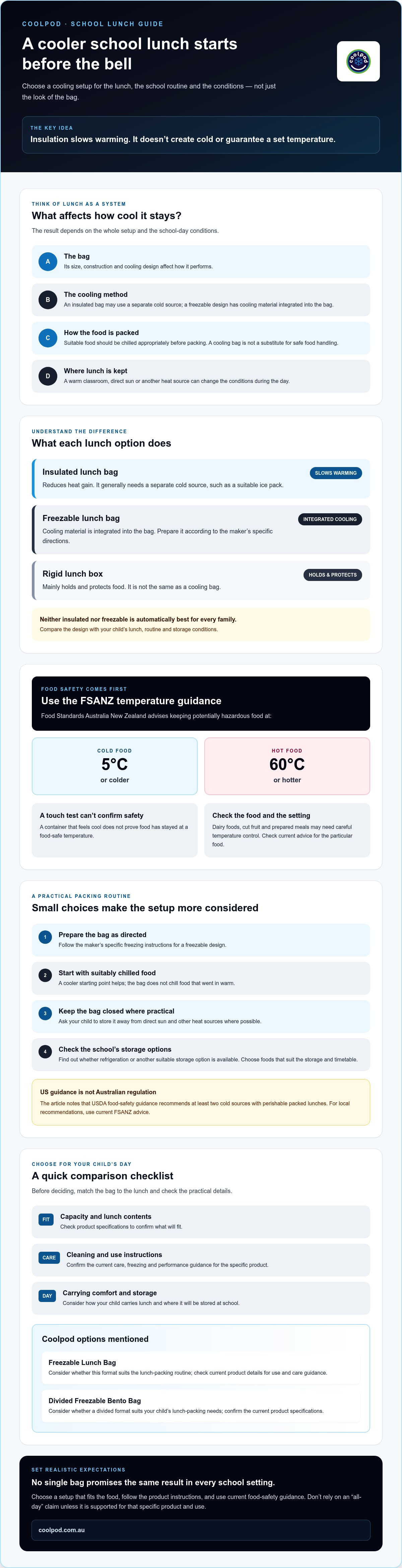
Food safety matters more than whether the outside of a container feels cool. Food Standards Australia New Zealand (FSANZ) advises keeping potentially hazardous food at 5°C or colder, or 60°C or hotter. A touch test can’t confirm a food’s temperature, and a product’s cooling performance depends on its design and use. Check current FSANZ advice and the bag maker’s instructions when planning lunches.
What does “stays cold all day” mean in a school setting?
It means choosing a setup that suits the time between packing and eating, where the lunch is stored and the weather. A lunch kept indoors and out of direct sun may face different conditions from one left in a hot area. Feeling cool to the touch doesn’t prove that food has stayed at a food-safe temperature. Don’t rely on an all-day duration unless it’s supported by evidence for that specific product and use.
Which foods need extra attention in a lunch box?
Dairy foods, cut fruit and prepared meals can need careful temperature control, depending on how they’re made and handled. Check current food-safety guidance for the particular food, and ask whether your child’s school has refrigeration or another suitable storage option. If reliable cooling isn’t practical for the timetable, choose lunch items that suit the available storage rather than taking chances with perishable food.
Think of the lunch as a system. Choose a bag and cooling approach that fit the day, start with food prepared and chilled appropriately, and account for where the lunch will be kept. That gives you a more realistic basis for comparing options than a promise based on the word “insulated” alone.
How do insulated and freezable school lunch bags keep food cool?
Insulation slows heat moving from the warmer surroundings into a lunch bag. It doesn’t generate cold or chill food that went in warm. A bag may use insulating layers to reduce heat gain, while a cold source helps keep the contents cool. Results depend on the design and how the bag is used, so “insulated” alone isn’t proof of a particular temperature or cooling duration.
Insulation slows warming; it doesn’t guarantee a set temperature. That’s the useful distinction to keep in mind when comparing a school lunch box that stays cold all day. Performance can vary with the bag’s size, how full it is, the food’s starting temperature and the conditions around it.
What is the difference between an insulated and a freezable lunch bag?
An insulated bag reduces heat gain but generally needs a separate cold source, such as a suitable ice pack. A freezable design has cooling material integrated into the bag, so the bag itself is prepared for use according to the maker’s directions. Neither approach is automatically better for every family. Consider what fits your routine, lunch contents and storage conditions.
Coolpod specialises in patented freezable bags, including a Freezable Lunch Bag. Check the current product information for its freezing, care and performance instructions rather than assuming every freezable bag works in the same way.
Why do freezing and packing habits matter?
Follow the specific freezing directions before using a freezable bag. Chilling suitable food before packing gives it a cooler starting point; a cooling bag isn’t a substitute for safe food handling. Keep the bag closed as much as practical, and ask your child to store it away from direct sun or other heat sources where possible.
For extra context, the US Department of Agriculture’s USDA food safety guidelines recommend using at least two cold sources with perishable packed lunches. That is US guidance, not Australian regulation, so use current Food Standards Australia New Zealand advice for local food-safety recommendations. It reinforces a practical point: cooling depends on preparation and handling, not just the bag’s outer material.
If integrated cooling sounds easier to manage than remembering a separate cold source, you can explore Coolpod’s freezable lunch bags and check each product’s current instructions before choosing.
How to compare a school lunch box that stays cold all day
Start by comparing how each bag cools, then check whether it suits your child’s actual lunch and school routine. Use this checklist: cooling design, usable capacity, fit, freezing routine, cleaning instructions and carry comfort. For a school lunch box that stays cold all day, look for clear instructions and product-specific performance information, not just reassuring wording or a thick-looking lining.
The table outlines practical differences between common approaches. None guarantees a specific temperature or duration, so follow the product instructions and consider the conditions the lunch will face.
| Approach | What to check | Practical consideration |
|---|---|---|
| Insulated-only bag | Construction details and whether a separate cooling source is needed | Insulation slows heat gain, but doesn’t chill food on its own. |
| Insulated bag with separate ice pack | Whether the pack fits securely alongside the lunch | You’ll need to freeze and pack the cold source separately. |
| Freezable bag | Freezing, care and performance instructions for that specific bag | Cooling material is integrated into the bag, which may simplify packing if it fits your freezer routine. |
For broader options and design differences, see this 2026 guide to freezable lunch bags. The USDA’s food safety advice for packed lunches discusses cold sources, including using more than one. It’s US guidance, so check current Australian food-safety advice for local recommendations.
Which features matter most for a child’s school day?
Test the size against the lunch container, drink and snacks your child usually takes. Confirm dimensions and capacity in the current product details rather than estimating from a photo. Check whether your child can open, close and carry the bag comfortably, and read how it should be cleaned. If you’re choosing a freezable design, make sure its freezing instructions work with your household routine.
When might a freezable bento bag suit a school lunch?
A divided lunch container can help keep different components organised, such as crackers, fruit and a sandwich. It’s a useful format if your child likes separate portions, but it isn’t essential for every lunch. Coolpod’s Freezable Bento Bag is one option to compare. Check its current dimensions and instructions against the container and foods you plan to pack. For more on this format, read the bento cooler bag selection guide.
How to pack a school lunch to keep it cool
A repeatable morning routine makes lunch packing easier and helps you use the cooling bag as intended. Small steps matter: chill suitable foods, prepare the bag correctly, pack thoughtfully and consider where it will sit at school. No routine removes the need to follow food-safety advice for the particular food.
What is a simple before-school cooling routine?
Use this sequence as a starting point, adjusting it to the bag’s instructions and your child’s lunch:
- Prepare the bag. The night before, follow its freezing and care instructions. Don’t assume every freezable bag needs the same preparation.
- Chill suitable foods. Keep perishable ingredients refrigerated until you’re ready to pack. A bag is designed to help with cooling, not to chill food that starts warm.
- Pack the lunch. Put cold items together and arrange them so they fit securely. If you use a separate cold source, position it as directed and make sure containers are closed properly.
- Close and check. Secure the bag to limit unnecessary exposure to warm air. Before handing it over, check that your child can open and close it without help.
- Choose a sensible spot. Ask your child to keep the lunch out of direct sun and away from heat where practical, and follow any storage arrangements the school provides.
Food Standards Australia New Zealand (FSANZ) advises keeping potentially hazardous food at 5°C or colder, or 60°C or hotter. For food that has been between 5°C and 60°C, check current FSANZ guidance on the two-hour/four-hour rule and how it applies to the food and circumstances. A lunch bag’s feel isn’t a reliable way to confirm food temperature.
What if the classroom or school bag gets warm?
Heat and storage conditions can affect how well any cooling setup works. Find out whether the school has a suitable place to store lunch, but don’t assume refrigeration is available. If the bag may be left somewhere warm, factor that into the lunch plan and choose foods appropriate to the conditions and timetable. Follow current food-safety advice if you’re unsure how long a perishable item can safely remain unrefrigerated.
Make the routine manageable for your child, too. Practise opening the bag, closing it fully and putting it in the agreed storage spot. To compare integrated cooling options for this routine, explore Coolpod’s freezable lunch bags and check the current instructions for the specific bag you’re considering.
Choosing a Coolpod option for your child’s school lunch
The best format is the one that fits the food your child eats, the way they carry lunch and the routine your household can manage. Coolpod is an Australian-owned specialist in patented freezable bag technology, with options including the Freezable Lunch Bag and Freezable Bento Bag. These offer integrated cooling, but neither should be treated as a guarantee of a particular temperature or all-day cooling time.
Before choosing a school lunch box that stays cold all day, compare the bag’s current product details with your real school-day needs. Check dimensions and capacity against the containers, drink and snacks you plan to pack. Read the freezing and care instructions so you know how to prepare and clean the bag. The right fit should work not only for lunch, but also for your child’s ability to carry and open it.
Is the Coolpod Freezable Lunch Bag the right format?
A straightforward lunch-bag format may suit families looking for integrated cooling without packing a separate cold source. Check the current capacity and dimensions against your child’s usual lunch container and drink, rather than relying on a product photo. Consider whether the freezing directions fit your routine and whether your child can manage the closure independently. Check product information for performance details, and don’t assume a specific cooling duration.
Would a freezable bento bag suit your lunch routine?
If your child likes different foods packed separately, a divided lunch container can help keep lunch components organised. Coolpod’s Freezable Bento Bag is an option to consider if you already use that style of container. Confirm the bag’s current specifications and check that your container fits. A bento format isn’t necessary if your child prefers a simple sandwich or another lunch arrangement.
Think about what will make mornings and lunchtime easier for your family. A format that matches your child’s food, school routine and carrying needs is more useful than choosing based on appearance alone. If you’re weighing up the two options, check current product information for dimensions, freezing directions, care and any stated performance details before deciding.
Ready to compare the available formats? Explore Coolpod’s freezable bags and see which option best suits your child’s school lunch routine.
Make school lunch cooling part of your routine
Choosing a school lunch box that stays cold all day means looking beyond the bag itself. Match the cooling approach to your child’s lunch and school routine, check the product’s dimensions and care instructions, and start with suitable foods chilled. Packing habits and storage conditions also matter, so avoid relying on an unverified all-day cooling promise.
A freezable bag may make the morning routine simpler by integrating cooling into the bag. Coolpod is Australian-owned and operated, and has specialised in patented freezable bag technology since 2010. Compare the Freezable Lunch Bag and Freezable Bento Bag with the containers your child uses and the way they prefer their lunch packed. Check current product details before choosing.
Ready to compare your options? Explore Coolpod’s freezable lunch bags and find a format that fits your family’s school-day routine. With a practical choice and a repeatable packing habit, you can send lunch off with greater confidence.
Frequently Asked Questions
Can a school lunch box stay cold all day?
A suitable bag and careful packing can help keep lunch cool, but a general description can’t guarantee a particular temperature until home time. The result depends on the food’s starting temperature, the bag’s design, how often it’s opened and where it’s stored. Choose a school lunch box that stays cold all day by checking product-specific instructions and performance information, then follow current Food Standards Australia New Zealand (FSANZ) advice for perishable foods.
How do I keep my child’s lunch cold until lunchtime?
Prepare the bag as directed, pack suitable foods chilled, close it securely and keep it away from direct heat where practical. Ask the school about storage arrangements rather than assuming a fridge is available. For perishable items, follow current FSANZ advice on safe handling and time out of refrigeration. A consistent routine helps, but the right approach also depends on the food, school day and storage conditions.
Are freezable lunch bags better than lunch boxes with ice packs?
Neither approach is automatically better for every family. A freezable bag has integrated cooling material, while an insulated bag may rely on separate ice packs. Compare how each option fits your routine, including preparation, capacity, cleaning and the manufacturer’s instructions. Check product-specific evidence rather than assuming a bag or ice-pack setup will maintain a particular temperature or stay cool for a set duration.
Should I freeze the whole lunch bag overnight?
Only freeze a bag if its manufacturer says it’s designed for that and explains how to prepare it. Follow the product’s directions for freezing, care and use; insulated bags aren’t all made for freezer storage. Pack suitable foods appropriately chilled as well. A frozen bag doesn’t make food safe by itself, so check current FSANZ guidance for the foods you’re packing and how they should be handled.
What should I pack in a school lunch on a hot day?
Choose foods that suit your child’s storage conditions and timetable, and take extra care with perishable items. Chill suitable foods before packing and use a cooling method according to its instructions. School environments and daily temperatures vary, so a generic lunch list can’t guarantee safe storage. Check current FSANZ advice for specific foods and handling, and ask the school about storage options rather than assuming refrigeration is available.
Is a freezable lunch bag safe for yoghurt and other dairy foods?
A freezable bag may help keep yoghurt and other dairy foods cool, but safe handling depends on the food’s temperature and how long it is stored. Follow the bag maker’s instructions and current FSANZ advice for dairy and other perishable foods. Don’t use touch or smell alone to decide whether food is safe. If you’re unsure how it has been stored, consult authoritative food-safety guidance before serving it.
How do I choose the right size school lunch bag?
Start with the containers, drink and snacks your child usually takes, then compare them with the product’s current dimensions and capacity. Allow the packed lunch to fit without forcing the closure, and consider whether your child can carry and open the bag comfortably. Check the care instructions too, including any freezing requirements, and think about whether the bag suits your freezer space and the school’s storage routine.


