

What if the lunch bag you rely on isn’t enough to keep your child’s food safe? A dependable routine matters just as much as the bag. For peace of mind food safety for kids lunch, focus first on how you prepare, chill and pack perishable food, then consider how it will be stored before lunchtime.
It’s understandable to wonder how long chilled food can stay out of the fridge, especially on a hot Australian day. An insulated or freezable bag can support your cooling plan, but it isn’t a food-safety guarantee or a substitute for safe handling.
This guide sets out a practical routine for packing perishable lunches, explains why time and temperature matter, and helps you decide what to do when you’re unsure about leftovers. It also compares cooling approaches, including cold sources and freezable lunch bags. Small, repeatable steps can make school-morning packing clearer and more manageable.
Key Takeaways
- Use a prepare, chill, pack, store and check routine to make lunch packing easier to repeat.
- Consider how food is handled, how cold it is when packed and where it will be stored.
- Compare insulated bags, separate cold sources and integrated freezable bags to find an approach that fits your child’s lunch.
- For peace of mind food safety for kids lunch, match your cooling approach to the food and school-day routine.
- No bag replaces careful preparation. Check storage directions for foods that need chilling.
Why food safety matters when packing kids’ school lunches
A sandwich with meat or a tub of yoghurt may sit in a school bag for hours before lunchtime. If you’re aiming for peace of mind food safety for kids lunch, don’t judge safety by whether food still looks or smells appealing. Food safety means reducing the chance of contamination during preparation and limiting the time perishable food spends at unsuitable temperatures.
Australian conditions make lunch planning worth a little extra thought. A hot day, a bag left in the sun or a later lunch break can all affect how long chilled food is away from refrigeration. Schools may differ in where lunch bags are kept, so check what storage is available rather than assuming the classroom will keep food cool. Cooling equipment can support a careful routine, but it cannot confirm that food has stayed safe.
Which lunch foods need extra temperature care?
Meat, dairy products and cut fruit are generally more perishable and need appropriate chilling. Some lunchbox staples, such as whole fruit, bread and crackers, are commonly packed without refrigeration. Check storage directions on food labels, particularly after opening, and follow your school’s food policies. If you’re unsure whether an item needs chilling, choose a safer alternative or check Australian food-safety advice.
What does “safe until lunchtime” actually depend on?
There isn’t one answer that applies to every lunch. The type of food, how cold it is when packed, how it was prepared, the cooling method and the time before it is eaten all matter. Clean hands, utensils and preparation surfaces also help reduce the risk of contamination.
A general overview of the temperature danger zone describes the range where bacteria can grow rapidly as roughly 4°C to 60°C. For advice relevant to Australian food handling, check current FSANZ guidance. A lunch bag that feels cool doesn’t confirm that every food inside stayed within safe conditions, so don’t rely on touch or appearance alone to assess a perishable item.
Assess the food, its starting temperature, how it was handled, the cooling method and the time until it’s eaten together. That’s more useful than relying on the bag alone. A repeatable routine can help you make a clear plan, even when the weather or school schedule changes.
How time, temperature and handling affect food safety
Perishable food needs careful temperature control because harmful bacteria can multiply when food is kept too warm. A lunch packed early may be carried around all morning before a later lunch break. The risk depends on the food and how it is handled, so don’t treat one time limit as a guarantee for every lunch or set of conditions.
For Australian advice, check current Food Standards Australia New Zealand (FSANZ) guidance on keeping food at safe temperatures, as well as storage directions on packaging. Use that guidance to plan how perishable ingredients are prepared, chilled and stored. It can’t confirm that a particular lunch stayed at a safe temperature throughout the school day, so consider the actual conditions too.
What Australian food-safety guidance should parents follow?
Use FSANZ advice as a starting point, then check your school’s requirements. Schools may have specific rules about lunch storage, food allergies or what children can bring. General food-safety guidance doesn’t replace school policies, and school arrangements don’t replace safe preparation at home.
Clean hands, utensils and containers help reduce contamination. Wash your hands before preparing lunch, use clean equipment and keep raw foods separate from ready-to-eat items where appropriate. Make these steps part of the routine, alongside chilling perishable food and packing it promptly.
How can hot weather change lunch planning?
Before packing, consider the forecast, where your child’s bag will be stored and how long it may be until their lunch break. A bag left in a warm spot faces different conditions from one kept somewhere cooler. On hot days, take extra care with perishable foods: start with them properly chilled, use a suitable cooling method and follow the label’s storage instructions.
If you can’t tell whether a perishable item has been stored safely, don’t rely on smell, appearance or a cool-feeling bag to decide. Discard food when you’re uncertain rather than taking a chance. A freezable lunch bag, including one with integrated cooling, may suit your routine, but it doesn’t replace safe preparation or handling.
For safer lunch planning, consider the food, its starting temperature, how it is handled, the day’s conditions and the time before it’s eaten. That’s a practical basis for peace of mind food safety for kids lunch, without expecting a bag or a fixed time promise to do all the work.
Do insulated or freezable lunch bags give parents peace of mind?
The right bag can make lunch packing easier, but it works best as one part of a food-safety routine. Perishable items still need to be chilled before packing, and clean preparation and careful handling matter whatever cooling approach you choose.
Here’s how common options differ:
| Cooling approach | Preparation needs | Everyday convenience | Important limitations |
|---|---|---|---|
| Insulated bag only | Chill perishable food before packing. | Simple to use and carry. | Insulation alone isn’t an active cold source and doesn’t confirm food stayed chilled. |
| Insulated bag with separate ice packs | Freeze the packs and position them with the food as directed. | Lets families choose and arrange their cold sources. | Requires remembering to freeze and pack the ice packs. Performance depends on the setup and conditions. |
| Integrated freezable bag | Prepare the bag according to its care and use instructions, and chill food before packing. | Built-in cooling can reduce the need to pack separate ice packs. | Don’t assume a particular holding time or treat the bag as a food-safety guarantee. |
What should parents compare before choosing a lunch bag?
Consider what you pack, how long it may be until lunch, the space food needs and whether your household can prepare the bag reliably each day. Check cleaning instructions and construction. If you need to assess cooling performance, look for verified product-specific information. Marketing phrases or a cool outer surface aren’t proof that food remained at a safe temperature.
For a broader product-selection overview, see this freezable lunch bag guide. For Australian temperature and handling advice, refer to current Food Standards Australia New Zealand (FSANZ) guidance alongside the product’s instructions.
When could integrated freezable cooling suit a school routine?
Integrated cooling may suit families who prefer not to remember separate ice packs. The Coolpod Freezable Lunch Bag has integrated cooling and doesn’t require separate ice packs. Follow the product’s instructions and keep chilled food handling as part of your routine.
Integrated cooling can add convenience, but it isn’t a food-safety guarantee. For peace of mind food safety for kids lunch, choose a bag that fits your routine and pair it with chilled food and careful preparation.
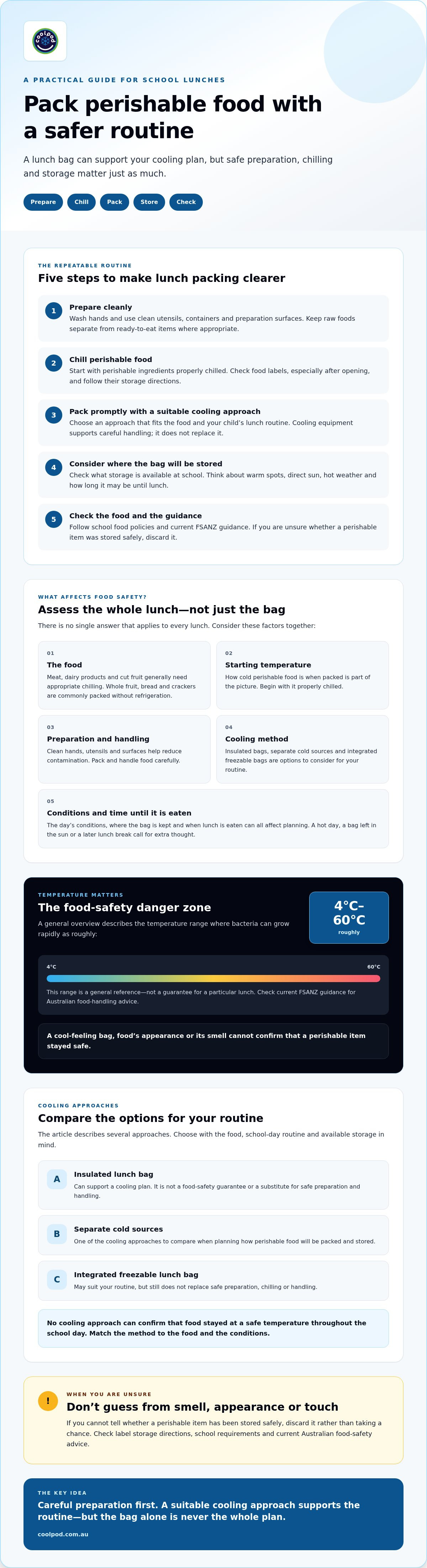
How to pack a safer school lunch: a repeatable daily routine
A routine makes busy mornings more manageable and helps you remember the details that matter. Use this sequence: prepare, chill, pack, store and check. Adjust it to the food, the weather and your school’s arrangements instead of relying on a bag alone.
- Prepare: Wash your hands and use clean utensils and containers. Handle ingredients safely, keep foods that need chilling separate from ready-to-eat items where appropriate, and follow storage directions on packaged foods.
- Chill: Refrigerate perishable ingredients before packing. Prepare a cooling bag or cold source according to its manufacturer’s instructions. Cooling equipment isn’t a substitute for chilling food before it goes into the bag.
- Pack: Put chilled perishable food into the prepared lunch bag promptly. Choose a bag and arrangement that fit the food, and make sure your child can open and manage it.
- Store: Check where lunch bags are kept at school and whether refrigeration is available. Ask about lunch-storage and allergy-management rules. On a hot day, or if lunch may be delayed, take extra care. Use the school’s recommended storage arrangements or choose foods that don’t need chilling.
- Check: After school, ask whether lunch was stored as planned and whether the break was later than expected. If you’re unsure a perishable item was kept safely, discard it rather than saving it for later.
What should happen before the lunch goes into the bag?
Keep the steps simple and consistent: clean hands, clean containers, safely prepared ingredients and properly chilled perishable food. Check labels for storage directions, especially for opened products. If you’re using a cooling bag, follow its care and preparation instructions each time. These checks support your cooling plan and help reduce contamination.
What should parents check after school?
A quick conversation can reveal useful details for tomorrow. Was the bag left in a warm spot? Did lunch run late? Did your child eat the perishable food, or bring it home? Don’t taste food to decide whether it’s safe. When in doubt, follow current Food Standards Australia New Zealand advice and discard uncertain perishable leftovers. Clean the lunch container and bag according to their care instructions.
Repeat the routine and adapt it when the forecast, school arrangements or lunch timing changes. If integrated cooling would make preparation easier for your family, explore Coolpod freezable lunch bags. They’re one possible part of a plan, alongside safe preparation and handling, not a substitute for them.
Choose a cooling approach that fits your child’s lunch routine
The best cooling option is one your family can prepare properly and your child can manage. Think about what’s in the lunch, where the bag will be stored, when the break is likely to happen and whether your child can open containers and repack leftovers independently. A lunch with perishable items needs a different plan from one made up of foods that don’t need chilling.
Whichever method you choose, prepare food safely and handle it carefully. Cooling equipment supports that routine; it doesn’t replace refrigeration before packing or prove that food stayed at a safe temperature during the school day. That’s the practical foundation for peace of mind food safety for kids lunch.
How can families make the routine easy to repeat?
A little organisation can take pressure off the morning rush. Keep clean containers, lunch bags and any separate cold sources together, and decide where prepared food will go in the fridge. Give your child a short, age-appropriate checklist, with supervision where needed:
- Pack the lunch bag and close it properly.
- Put it in the agreed school storage spot.
- Keep the bag closed until lunchtime, if that’s practical.
- Bring home uneaten perishable food for an adult to assess and discard if its safety is uncertain.
Review the plan when school timetables change, lunch is delayed or hot weather affects where bags are kept. If the school has specific storage or allergy requirements, include them in your routine.
Where can a freezable lunch bag fit into the plan?
If remembering separate ice packs makes weekday preparation harder, an integrated freezable bag may be a convenient alternative. The Coolpod Freezable Lunch Bag has integrated cooling and doesn’t require separate ice packs. Follow its use and care instructions, and don’t assume a particular safe holding time unless product-specific evidence supports it.
Built-in cooling can simplify packing, but safe food handling still does the essential work. Match the bag to your child’s lunch and daily routine, then keep preparation steps consistent. If you’d like to compare options, explore Coolpod’s freezable lunch bags as one possible part of your family’s lunch-cooling plan.
Make tomorrow’s lunch routine easier
Food-safety confidence comes from the steps you repeat, not a lunch bag alone. Chill perishable ingredients before packing, keep hands and containers clean, and consider the food, the day’s conditions and when your child will eat. If plans change or you’re unsure an item was stored safely, take a cautious approach.
Choose cooling equipment to suit your child’s lunch and what your family can prepare consistently. A freezable lunch bag with integrated cooling can be convenient if you’d rather not pack separate ice packs, but it doesn’t replace safe preparation and handling. Coolpod is Australian-owned and operated, and describes its products as food-safe. That description isn’t a guarantee that a particular lunch will remain safe in every situation.
For peace of mind food safety for kids lunch, keep the routine practical and adapt it when the weather or school arrangements change. Consider whether integrated cooling suits the way your family packs lunch.
A few thoughtful habits can make school-morning packing feel simpler. Build on the routine that works for your household, and adjust it when the lunch or conditions change.
Frequently Asked Questions
How long can food stay in a child’s lunch bag?
There’s no single duration that applies to every food and lunch situation. Check current Food Standards Australia New Zealand (FSANZ) advice, and consider the food type, how cold it was when packed, where the bag was stored and how it was handled. Follow storage directions on packaged foods and any school requirements. If you’re unsure whether a perishable item stayed safe, discard it rather than relying on smell or appearance.
Is an insulated lunch bag enough to keep kids’ food safe?
No. An insulated bag can support lunch storage, but it doesn’t prove that perishable food stayed safely chilled. Chill food before packing, choose a suitable cooling approach and consider how long the lunch may be stored and the conditions around it. Check current Australian food-safety guidance for advice that fits the food you’re packing. Don’t rely on unsupported claims about how long a particular bag keeps food safe.
Can I pack yoghurt or a cheese sandwich for my child’s lunch?
Yes, provided you follow the food’s storage directions and use an appropriate plan to keep perishable ingredients chilled. Yoghurt and some cheese fillings need temperature care, so consider how they’re prepared, packed and stored before the lunch break. Check current FSANZ advice and your school’s lunch-storage rules. Don’t assume a particular bag makes yoghurt or a cheese sandwich safe for a set period.
What is the safest way to pack a school lunch on a hot day?
Prepare lunch with clean hands and containers, chill perishable ingredients before packing, and use a suitable cooling method according to its instructions. Consider the forecast, where your child’s bag will be kept and when they’ll eat. Follow current FSANZ advice rather than relying on a universal time limit. If you can’t tell whether a perishable item was stored safely, discard it instead of judging by smell or appearance.
Do freezable lunch bags need an ice pack as well?
It depends on the specific bag, so follow its use instructions. That convenience doesn’t establish how long food will remain safe or guarantee that it will stay safely chilled. Chill perishable food before packing, handle it carefully and use current food-safety advice to guide your routine.
What should I do if my child brings home an uneaten lunch?
Consider what the food is, how cold it was when packed, how the bag was stored and how long the food remained uneaten. Check packaged food storage instructions and current FSANZ advice before deciding whether to keep anything. If you’re uncertain about a perishable item, discard it. Don’t taste it or rely on its smell or appearance to determine whether it’s safe.
How can I teach my child to handle their lunch safely at school?
Give your child a simple routine suited to their age: put the lunch bag in its agreed storage place, close it after taking food out and eat perishable items at the planned break. Check the school’s storage rules so your instructions match what’s possible there. These habits support safe preparation and suitable temperature control, but they don’t replace the care needed when packing lunch at home.
Explore Coolpod’s freezable lunch bags to see whether integrated cooling fits your family’s lunch routine.


