

What if the most portable cooler bag isn’t right for your medication? Searching for a “mini freezable cooler bag australia” option may bring up compact designs, but small size and built-in cooling don’t show whether a bag can keep your medicine within its required temperature range.
A lightweight option can be convenient for everyday trips or travel, and integrated cooling may be simpler than carrying separate ice packs. First, check the medicine’s label or ask your pharmacist about its storage requirements. Then compare those requirements with the bag’s product guidance, cooling method and intended use.
This guide covers what to check before choosing, how integrated cooling differs from separate ice packs, and why portability doesn’t prove a bag is suitable for a particular medicine. Coolpod’s freezable bags are designed for food and drinks, so check current product guidance before considering one for medication. Use the practical criteria below to assess whether a compact option’s intended use matches your medicine’s storage needs.
Key Takeaways
- Before choosing a mini freezable cooler bag australia, check the medicine’s storage instructions or ask a pharmacist what conditions it needs.
- Understand the difference between insulation and a cooling element, and check the bag’s preparation instructions.
- Compare the bag’s dimensions and capacity with your medicine, its original packaging and any accessories you need to carry.
- Consider your trip length and the exact product’s cooling guidance when assessing whether its cooling method suits your plans.
- Coolpod bags offer integrated cooling for food and drinks. Check current product guidance and ask a pharmacist before using one for a specific medication.
Mini freezable cooler bag Australia: start with your medication’s storage needs
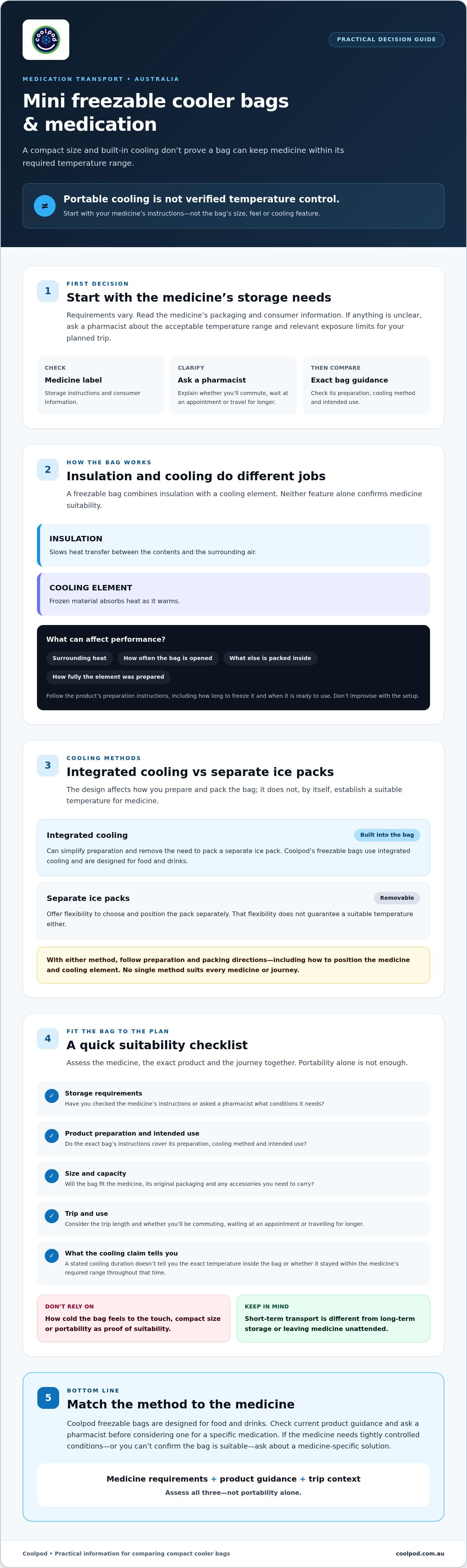
A mini freezable cooler bag has integrated material that you chill or freeze before use. It can make carrying items more convenient, but a bag designed for lunches or drinks hasn’t necessarily been tested or validated for storing medicine. The key question isn’t simply whether the bag feels cool. It’s whether its cooling method suits the medicine’s stated storage requirements for the whole journey.
Start with the medicine, not the bag. Read the storage instructions on its packaging and in the consumer information. If anything is unclear, ask a pharmacist about the acceptable temperature range and how long the medicine can be exposed to conditions outside it. Requirements vary, so don’t assume one temperature range applies to every medicine.
Temperature-sensitive medicines may need careful handling during transport, a concept associated with the cold chain. A portable cooler may help with carrying, but it doesn’t confirm that the required conditions have been maintained.
Portable cooling can help with transport, but it isn’t the same as verified temperature control. Keep that distinction in mind when comparing a mini freezable cooler bag in Australia with options designed specifically for medicines.
What storage temperature does your medication require?
Use the medicine’s packaging and consumer information as your starting point. If the instructions aren’t clear, ask a pharmacist what temperature range is acceptable and what exposure limits matter during your planned trip. Explain whether you’ll be commuting, waiting at an appointment or travelling for longer. This gives the pharmacist context to help you understand the medicine’s requirements, rather than relying on a bag’s general cooling claims.
Don’t judge suitability by how cold the bag feels to the touch. Check the exact product’s preparation and use instructions, and ask whether its cooling approach fits the medicine’s requirements. If the guidance doesn’t cover your situation, seek advice before relying on the bag.
When is a mini cooler bag worth considering?
A compact bag may be convenient for carrying medicine during a commute, appointment or day trip, especially if you want a lightweight option. But short-term transport is different from long-term storage or leaving medicine unattended. A freezable bag shouldn’t replace the storage method specified for the medicine.
If the medicine needs a tightly controlled temperature, or you can’t confirm that a general-purpose bag is suitable, ask your pharmacist about a medicine-specific solution. Consider the medicine, trip length and product instructions together. That’s a more useful starting point than choosing by size or portability alone.
How freezable cooler bags work, and what that means for medication
A freezable bag combines insulation with a cooling element. Insulation slows heat transfer between the contents and the surrounding air, while the frozen material absorbs heat as it warms. These features can help keep contents cool, but they don’t automatically maintain a particular temperature around medication.
Follow the product’s preparation instructions, including how long to freeze it and when it’s ready to use. Keep medicine in its original packaging and pack it as directed by the bag manufacturer. Don’t improvise with the setup. Surrounding heat, how often the bag is opened, what else is packed inside and how fully the cooling element was prepared can all affect performance.
When comparing a mini freezable cooler bag Australia option, look beyond the cooling feature. Check what the specific bag is designed to carry and whether its instructions address your intended use.
Integrated cooling compared with separate ice packs
Integrated cooling is built into the bag, which can simplify preparation and remove the need to pack a separate ice pack. Coolpod’s freezable bags use integrated cooling and are designed for food and drinks. That design feature alone doesn’t establish suitability for a particular medicine.
Removable ice packs offer flexibility because you can choose and position them separately, following the product’s instructions. But that doesn’t guarantee a suitable temperature either. With either method, check the preparation and packing directions, including how to position the medicine and cooling element. No single method suits every medicine or journey.
Why cooling duration does not prove medicine suitability
A stated cooling duration doesn’t tell you the exact temperature inside the bag or whether it stayed within a medicine’s required range throughout that time. A claim about keeping food or drinks cool isn’t evidence that the product has been tested to store a specific medicine within its required limits.
A cooling-time claim describes how long cooling may last; it doesn’t verify the temperature your medicine experienced. If you can’t tell whether the medicine went outside its acceptable range, or how long it can tolerate that exposure, ask a pharmacist before relying on the bag. To see how integrated cooling is used for everyday food and drink, explore Coolpod’s freezable bags, then check the current guidance for the exact product and intended use.
Compare mini freezable cooler bags by size, cooling and daily use
Product listings can use similar language to describe quite different bags. Compare the details that affect your routine, and check each product’s specifications rather than assuming all compact coolers work alike. This framework can help you assess a mini freezable cooler bag Australia shoppers might consider, without mistaking general cooling features for evidence of medicine suitability.
Use the table to identify what to verify. It’s a comparison guide, not a statement about the dimensions or performance of any particular product.
| Bag type | Dimensions | Cooling method | Preparation | Care instructions |
|---|---|---|---|---|
| Integrated freezable bag | Check listed measurements and whether they’re internal or external. | Cooling material is built into the bag. | Check how the bag must be frozen or chilled before use. | Follow the product’s stated cleaning and storage directions. |
| Bag with separate ice pack | Allow room for the contents and the pack without straining the closure. | A removable cooling pack is placed inside the bag. | Check the pack’s preparation and placement instructions. | Check care directions for both the bag and pack. |
| Insulated bag without a cooling element | Compare usable space with the packed items. | Insulation slows heat transfer but doesn’t provide active cooling by itself. | Check whether the product requires any preparation. | Use the manufacturer’s cleaning instructions. |
How much space should a mini cooler bag have?
Measure the medicine in its original packaging, then include any accessories you need to carry. Compare those measurements with the bag’s usable internal space, not just its outside dimensions. Leave enough room for the closure to shut comfortably without crushing, bending or compressing the packaging. If a listing doesn’t say whether its dimensions are internal or external, ask the seller before choosing.
Which features make everyday carrying easier?
Think about your route as well as the bag. Check its weight, handle or strap, closure and how easily you can reach the contents while travelling. Read the care instructions and confirm whether the bag needs freezing before each use. Don’t assume it’s leak-resistant, washable or especially durable unless the product information supports that claim.
Capacity matters too. A bag that fits the medicine but leaves no room for required accessories may not suit your day. If you’re also comparing options for meals, see this freezable lunch bag guide. For medication, assess the bag against the medicine’s storage requirements and the manufacturer’s guidance, not convenience alone.
Use this checklist before buying a mini medication cooler bag
A checklist helps you compare products without assuming that “freezable” means suitable for every medicine. Before choosing a mini freezable cooler bag Australia shoppers might find, confirm the medicine’s needs, the journey and the exact product instructions.
- Confirm the medicine’s storage requirements. Check its packaging and consumer information. Does it need refrigeration, or protection from heat and light? Ask a pharmacist about acceptable temperature limits, particularly if the medicine must stay within a narrow range.
- Consider the trip length and conditions. How long will the medicine be carried, and might it be exposed to hot weather, a warm vehicle or delays? A bag suited to a short trip may not be appropriate for extended or unattended storage.
- Check dimensions and capacity. Measure the medicine in its packaging and include any required accessories. Confirm whether the listed dimensions are internal or external, and leave room to close the bag without bending or crushing anything.
- Read instructions for the exact product. Identify whether cooling is integrated or uses a separate pack. Check how it must be prepared, how to pack the contents and what care instructions apply. Look for product guidance on the intended use rather than relying on a general cooling claim.
- Plan for packing and changes during travel. Keep medicine in its original packaging unless a pharmacist advises otherwise. Follow professional and product guidance on whether it should be kept apart from a frozen surface. Know what to do if the journey is delayed or storage conditions change.
Questions to ask before choosing a bag
Ask the product maker whether its instructions cover carrying your type of medicine and clearly explain the cooling method and preparation. If they don’t, don’t fill the gaps with assumptions. A pharmacist can help interpret the medicine’s requirements and explain what to do if it may have been exposed to unsuitable conditions.
Once you know what to check, you can explore Coolpod’s freezable bag range for compact food and drink options. Integrated cooling is a product feature, not confirmation that a particular bag is appropriate for your medicine. Check current product guidance and ask your pharmacist before using one for that purpose.
Is a Coolpod mini freezable cooler bag right for your needs?
Coolpod’s freezable bags use integrated cooling, which may appeal if you prefer a compact carry option without a separate ice pack. The range is designed for food and drinks, including lunch and snack options. That makes it worth considering for everyday outings when you’re carrying food or beverages, but it doesn’t establish that a particular bag can safely store your medication.
If you’re searching for a mini freezable cooler bag Australia option for medicine, make your decision in this order: check the medicine’s storage instructions, ask a pharmacist about transport requirements, then compare those needs with the exact bag’s current product guidance. Confirm its dimensions, preparation directions and stated intended use before buying. If the product information doesn’t address your intended use, don’t assume integrated cooling is enough.
Who may prefer an integrated freezable design?
An integrated design can suit people who want a compact, reusable bag for carrying snacks or drinks on everyday outings and would rather not pack separate ice packs. Built-in cooling may simplify preparation, but convenience isn’t medical verification. If you’re considering carrying medicine as well, compare the specific product instructions with the medicine’s transport requirements and ask a pharmacist whether the arrangement is appropriate.
Planning to use a bag for snacks too? The snack-sized bento bag guide can help you compare food-carrying options. Keep the decisions separate: a bag that works for snacks isn’t automatically suitable for medicine.
When to choose a dedicated medical transport solution
If your medicine needs tightly controlled temperatures, don’t rely on a general-purpose freezable bag unless its product guidance supports your intended use and a pharmacist agrees it matches the medicine’s requirements. Ask about any need to monitor temperature, how long the medicine can be carried, and what to do if travel is delayed or storage conditions change. A pharmacist can help you assess whether a dedicated medicine transport solution is needed.
Coolpod’s integrated cooling is a feature of its food and drink bags, not proof that they maintain a required medicine temperature. Confirm suitability with both the exact product guidance and your pharmacist before use. To compare Coolpod’s freezable bags for food and beverages, explore the freezable bag range and check the current product details before purchase.
Choose a cooling option that matches your next trip
Start with the medicine’s storage instructions, not the size or cooling claim of a bag. Check the required temperature and exposure limits with a pharmacist, then compare the journey, product preparation directions and available space. A compact mini freezable cooler bag australia shoppers are considering may be convenient, but general-purpose cooling doesn’t confirm that it’s suitable for a specific medicine.
Coolpod is an Australian-owned business offering patented freezable bags for food and drinks. Its integrated cooling designs are intended for portable use without separate ice packs. Check the current details for the exact bag and confirm its suitability for your medication with a pharmacist before relying on it for transport.
For compact food and drink options, explore Coolpod’s freezable bag range and check the product details. Match the medicine’s requirements to the journey and the product guidance before choosing a transport option.
Frequently Asked Questions
Can I use a mini freezable cooler bag for medication?
Possibly, but check the medicine’s storage instructions and ask a pharmacist before relying on a general-purpose bag. A freezable design may help with portable cooling, but that doesn’t show whether it keeps the medicine within its required temperature range. Read the exact product’s preparation directions, intended use and limitations. Take extra care if the medicine has strict temperature requirements, and don’t assume a bag is suitable based on its size or cooling claims alone.
How do I keep medication cool while travelling in Australia?
Ask a pharmacist how to manage your medicine for the expected journey length and conditions, then choose a transport option that matches their advice. Keep the medicine in its original packaging where appropriate, and plan for possible delays or changes in storage conditions. A cooler bag’s advertised duration doesn’t guarantee that your medicine will stay within its required temperature range, so check the product guidance and don’t rely on duration claims alone.
Does a freezable cooler bag need ice packs?
Not always. Some freezable bags have integrated cooling and are designed to be frozen before use, so they may not need separate ice packs. Follow the preparation directions for the exact product rather than assuming all bags work alike. If you’re carrying medication, ask a pharmacist whether that cooling method suits its storage requirements and whether the medicine needs protection from direct contact with frozen surfaces.
How long will a mini freezable cooler bag keep contents cold?
Cooling time depends on the specific product, how it’s prepared, surrounding conditions, how often it’s opened and what’s packed inside. A stated duration doesn’t confirm the exact temperature inside the bag or prove that it remains suitable for medicine storage. For a medicine journey, check product-specific evidence and ask a pharmacist whether the bag suits both the medicine’s requirements and the expected travel conditions.
Can medication go directly against the frozen lining?
Don’t assume direct contact is appropriate. Check the medicine’s packaging and ask a pharmacist how it should be packed, as some medicines may have particular temperature limits or handling instructions. Follow the bag maker’s directions too. If they don’t cover medicine use, seek professional advice before relying on the bag. Keeping medicine in its original packaging, where appropriate, can also help protect it and make it easier to identify.
What should I look for in a small medication cooler bag?
Start with the medicine’s storage requirements, then compare the bag’s internal dimensions, cooling method and preparation instructions. Check the closure, portability and cleaning guidance, and make sure the medicine fits in its packaging alongside any required accessories. Consider the journey length and the conditions the bag may face. If you’re comparing a mini freezable cooler bag in Australia for medicine, ask a pharmacist whether a general-purpose option is appropriate.
Are Coolpod freezable bags suitable for every medication?
No. Coolpod is an Australian-owned business selling patented freezable bags designed for food and beverages, with integrated cooling for portable use without separate ice packs. A general product mention of medical items doesn’t confirm that a particular bag suits a specific medicine. Check the current guidance for the exact product and ask a pharmacist about the medicine’s temperature limits, journey duration and packing needs before use.


