

That trusty blue gel pack at the bottom of your esky might actually be the biggest threat to your midday meal. We have all been there; you open your lunch bag at the arvo break only to find a sandwich that's more sponge than snack. It is a frustrating reality that highlights the common problems with cooler bag ice packs, from constant condensation to the sheer bulk that leaves no room for actual food.
We understand that keeping your family's food fresh in the harsh Australian heat shouldn't involve a soggy mess or hidden safety risks. Recent events, like the Kmart Anko gel pack recall in early 2026 due to toxic ethylene glycol, have made many of us rethink what we're putting next to our kids' fruit. In this guide, you'll discover why traditional cooling methods are failing you and how to transition to a smarter, safer alternative that keeps everything crisp and dry. We will explore the hidden downsides of leaky packs and reveal the integrated technology that reclaims your bag space while providing superior, non-toxic protection.
Key Takeaways
- Learn why condensation is the primary culprit behind soggy sandwiches and how humidity inside your bag impacts food quality.
- Identify the safety risks of chemical leaks and why understanding the problems with cooler bag ice packs is essential for protecting your family.
- Discover how to maximise your bag’s "payload" by removing bulky, inefficient cooling elements that take up room meant for food.
- Understand why traditional ice packs often fail before the midday break in the Australian sun and how to achieve more consistent cooling.
- Explore the advantages of integrated freezable technology that provides a non-toxic, mess-free solution for keeping lunches cold all arvo.
The "Wet Sandwich" Syndrome: Why Ice Packs Cause Condensation
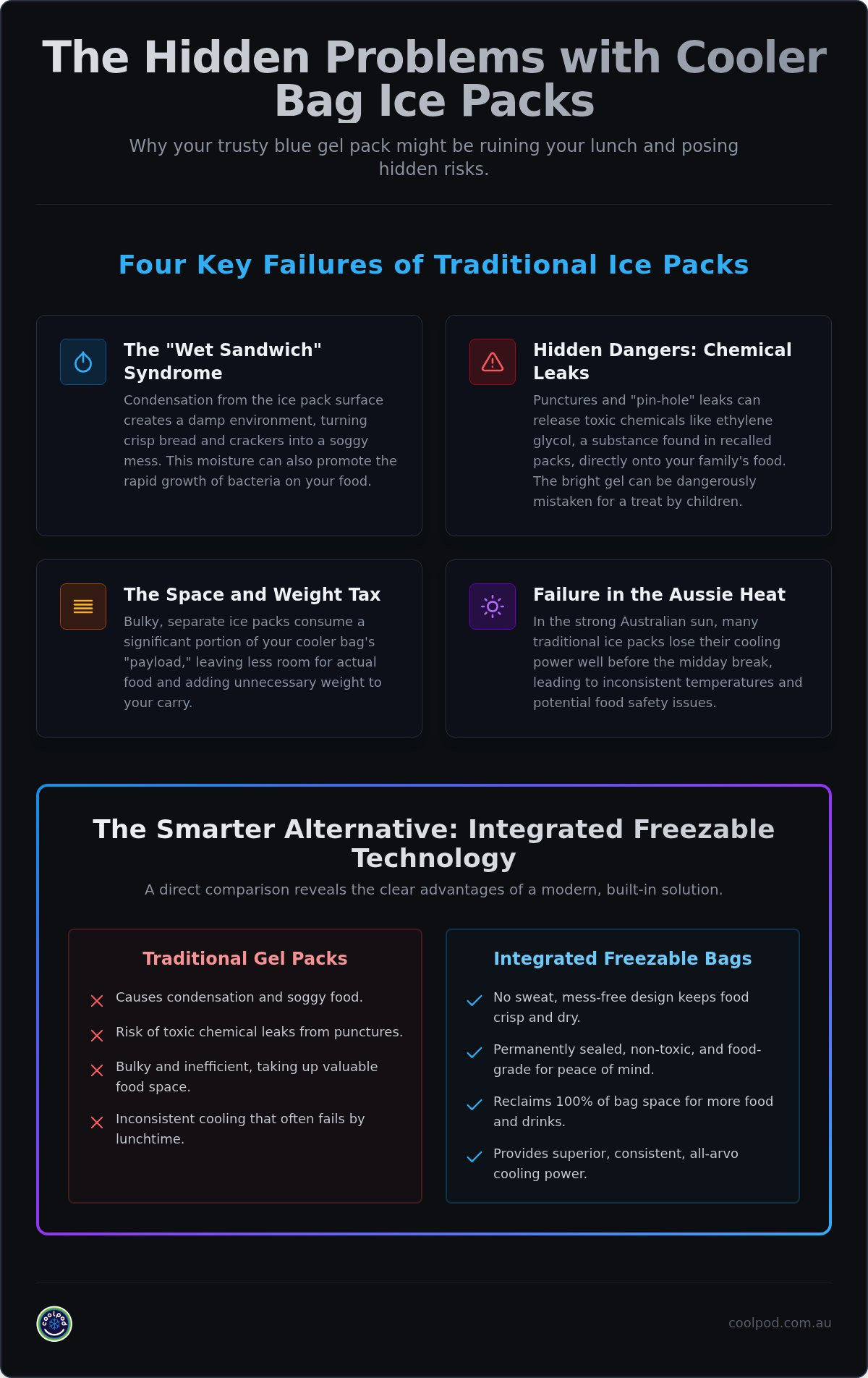
Opening your lunch bag to find a soggy salad or a damp sandwich is more than just a disappointment; it's a design failure. One of the most persistent problems with cooler bag ice packs is the unavoidable "sweat" they produce as they sit in your bag. This moisture isn't usually a leak from the pack itself, but rather the result of warm, humid air hitting the freezing cold surface of the pack. It turns your midday meal into a damp mess before the morning tea break even arrives.
Many of us try to manage this by wrapping our ice packs in tea towels or extra napkins. While this might help for the first hour, it is a bulky and ineffective fix. Once that towel becomes saturated, it simply holds the cold moisture against your food containers or paper-wrapped snacks. This ruins the texture of your bread and turns crisp crackers into a soft, unappealing disaster. You lose precious space in your bag for a solution that ultimately fails when the Australian humidity kicks in.
The Physics of Condensation in a Cooler Bag
When the refrigerant gel inside a standard pack begins to absorb heat, the surface temperature remains significantly lower than the surrounding air. This temperature differential pulls moisture out of the air, forming droplets that eventually pool at the bottom of your bag. Standard insulated liners are often made of non-porous materials that cannot absorb this volume of "sweat," leaving your lunch to sit in a shallow puddle. Large air pockets in your bag accelerate this process. Every bit of empty space is filled with humid air that fuels more condensation and speeds up the melting process.
Health Risks of a Damp Lunch Environment
A damp lunch bag isn't just unpleasant; it can be a breeding ground for trouble. Moisture promotes the rapid growth of bacteria on porous surfaces like bread, crackers, or fruit skins. If you use paper bags, the moisture can cause them to disintegrate, leading to cross-contamination between different food items in your bag. In the context of food safety, moisture-wicking refers to the ability of a material to pull liquid away from food surfaces to prevent the damp conditions that allow microbes to thrive. Without this, your lunch bag becomes an accidental incubator for germs on a warm day.
Hidden Dangers: Chemical Leaks and Toxicity
Safety is a top priority for any parent, yet the cooling elements we tuck into school lunchboxes often escape scrutiny. While we focus on healthy snacks, we might overlook what is actually inside those gel packs. Most reusable options contain a mix of water, thickening agents like sodium polyacrylate, and chemicals to lower the freezing point. Some packs may contain toxic substances such as propylene glycol or even ammonium nitrate. The risk became a reality in January 2026, when a major Australian retailer was forced to recall gel packs found to contain ethylene glycol, a highly toxic chemical that can be fatal if swallowed.
The "pin-hole" problem is one of the most insidious problems with cooler bag ice packs. Because these packs are frequently squeezed into tight spaces or dropped by kids, the plastic casing can develop microscopic punctures. You might not even notice a leak until it is too late. This "stealth" leak often manifests as a thin, clear film on your fruit or sandwich wrap. For a young child, a leaking pack is a significant hazard; the bright blue or clear gel can easily be mistaken for a squeeze-yoghurt or jelly. If you discover a compromised pack, do not simply pour the contents down the sink. Wrap the entire unit in a sealed plastic bag and dispose of it in your general waste to prevent chemicals from entering the local water system.
Identifying a Compromised Gel Pack
Routine inspections can prevent a mess before it starts. Hold your gel pack up to the light and look for "stress fractures," which appear as faint white lines or cloudy patches in the plastic where it has been repeatedly bent. You can also perform the sticky residue test; if the outside of the pack feels tacky or greasy even after a wash, it is likely weeping fluid through the pores of the plastic. Never attempt to "tape up" a leaking pack. Adhesives fail quickly in the freezing and thawing cycles of an esky, and the chemicals will eventually migrate past the tape and onto your food.
Safe Alternatives for Peace of Mind
Transitioning to a food-grade, integrated cooling system is the most reliable way to eliminate these risks. When the cooling element is permanently sealed within the walls of the bag, there is no loose pack to split, leak, or be tampered with by curious little fingers. This design provides a much higher standard of protection for your family's daily meals. Learning how to properly clean and store your freezable bag will help maintain its integrity for years of use. It is a smarter, non-toxic approach that ensures your only concern at lunchtime is what's on the menu.
The Space and Weight Tax: Why Separate Packs Are Inefficient
Carrying a lunch bag that feels like a lead weight is a common gripe for Aussie commuters. When you calculate the "payload" of your daily kit, you often find that the cooling elements take up more room than your actual meal. It is one of the most annoying problems with cooler bag ice packs; they are heavy, rigid, and fundamentally inefficient. You buy a bag that looks spacious on the shelf, only to realise it barely fits a sandwich and a single apple once you wedge those bulky blue bricks inside. This lack of space often forces you to leave behind healthy snacks or larger water bottles, defeating the purpose of bringing a lunch from home.
This extra weight does more than just tire your arm. Heavy ice packs cause "lunch bag sag," where the bottom of the bag bows under the pressure. Standard bag straps aren't designed to carry the equivalent of a house brick alongside your meal, leading to frayed seams and uncomfortable carrying. Over time, this stress leads to strap failure or zips that pop under the strain of an uneven load.
Volume Comparison: Ice Pack vs. Integrated Cooling
Standard gel packs are thick and consume a massive portion of your usable volume. Adding just two of these can reduce your storage capacity significantly. In contrast, integrated cooling technology built into the walls provides a slimline profile that reclaims that lost space. This 360-degree cooling is far more effective than a single cold brick. Instead of one freezing spot that leaves the rest of your food lukewarm, you get consistent protection from every side. It is a smarter way to organise your gear, ensuring every centimetre of the bag is used for nutrition rather than plastic.
Durability Issues with Daily Commuting
Shifting ice packs are a major cause of "lunchbox carnage" during a busy morning commute. As you move, those heavy bricks slide around, easily crushing delicate fruit or flattening your sandwiches. Beyond the food, the constant freezing and thawing cycles eventually compromise the plastic integrity of the pack itself. This leads to the leaks and ice pack chemical toxicity concerns mentioned earlier. For those who need a more rugged and reliable solution for the worksite or the office, exploring professional lunch bag styles for men in 2026 can provide a more streamlined, durable alternative for the daily grind. Using a bag with built-in cooling eliminates the risk of heavy packs damaging your zips or tearing the internal lining.
Performance Failures in the Australian Heat
The Australian Summer is the ultimate testing ground for insulation, and most standard gear simply isn't up to the task. One of the most common problems with cooler bag ice packs is the "Half-Day" failure. You pack your lunch at 7:00 AM, but by the 11:00 AM smoko, the ice pack has already turned into a lukewarm bag of water. This happens because a single cooling element lacks the thermal mass to fight off ambient temperatures that often soar above 30°C. In these conditions, heat doesn't just creep in; it attacks through "thermal bridges" in thin bag walls and uninsulated zips.
Unlike a large, thick-walled esky that relies on a massive volume of ice to stay cold for days, a personal lunch bag is small and vulnerable. Every time you unzip it to grab a piece of fruit or a drink, you let out the precious cold air and invite in a rush of warm, humid air. This creates a cycle of rapid melting that most separate packs cannot recover from. The "Esky" approach of throwing in a single brick doesn't work for a small bag because the physics of heat exchange are stacked against you.
Thermal Dynamics of a Standard Cool Bag
In a typical setup, the area directly touching the ice pack stays freezing, while the opposite corner of the bag remains far too warm. This creates "cold zones" and "danger zones" within the same small space. If your food reaches a temperature above 5°C, it enters the bacterial danger zone where pathogens can double every twenty minutes. To ensure safety, your insulation needs to be thick enough to resist the external heat-sink effect of a hot car or office, rather than relying solely on a single, shrinking cold source at the bottom of the bag.
Survival Tips for the Australian Job Site
Keeping your fuel fresh on a job site requires a bit of strategy. Never leave your bag on the metal tray of a ute or in direct sunlight; these surfaces act as heaters that rapidly drain your cooling power. A better approach is to pre-chill your bag in the fridge overnight before you pack it. This ensures the insulation is already cold, rather than wasting the ice pack's energy cooling down the bag itself. For those working in demanding conditions, choosing the ultimate men’s lunch kit for the Australian job site can make the difference between a crisp lunch and a safety risk. You need a solution designed specifically for local conditions, so consider upgrading to a high-performance freezable lunch bag that surrounds your food with 360-degree cooling.
The Smarter Alternative: Patented Freezable Technology
Most Australians spend years searching for the perfect separate cooling accessory, but the reality is that the concept itself is fundamentally flawed. The most effective way to solve the persistent problems with cooler bag ice packs is to eliminate the separate pack entirely. With the Coolpod system, the bag actually is the ice pack. By integrating patented freezable technology directly into the insulated walls, we have created a 360-degree cooling environment that surrounds your food from every angle. This isn't just a minor design tweak; it is a total rethink of how to keep meals fresh in a warm climate.
Reclaiming your bag space is one of the most immediate benefits of this integrated approach. You no longer have to sacrifice your afternoon snack or a larger drink bottle to make room for a heavy, frozen brick. Because the cooling element is a permanent, sealed part of the bag, it is designed for thousands of uses without the risk of splitting or weeping chemicals onto your fruit. Our materials are non-toxic and food-safe, providing a level of security for the kids that loose, retail-grade gel packs simply cannot match. It is a streamlined solution that prioritises both your health and your hunger.
For businesses that require more than personal cooling gear, such as professional-grade custom packaging solutions for their own products, click here to see how Packaging For Industry (PFI) can help.
Why Coolpod Beats the Traditional Ice Pack
Condensation is the primary enemy of a crisp lunch, and our design tackles this head-on. The fabric-gel interface in a Coolpod is engineered to reduce the "sweating" that leads to soggy bread and damp crackers. It is a more intelligent way to manage moisture compared to a bare plastic pack sitting in a puddle. Durability is also a key factor; these bags are built to withstand the daily school run, the office commute, or a long day on the road. Ease of use is the final piece of the puzzle. There is no searching for lost packs in the bottom of the freezer; you just pop the entire bag in overnight, and it is ready to go by sunrise.
Choosing the Right Freezable Solution
Every lifestyle has different requirements for keeping food chilled. Whether you need a Coolpod Freezable Bento Bag for the kids' school lunches, a Coolpod Freezable Wine Cooler for a weekend barbie, or a Coolpod Freezable Yoghurt Bag for a healthy midday snack, there is a specialised design ready for the task. We even offer a Coolpod Freezable Drink Cooler Bag to ensure your beverages stay crisp in the summer sun. As a Melbourne-based specialist, our engineering is specifically tailored for local conditions and the harsh Australian heat. It is time to stop settling for damp, lukewarm sandwiches and start using a system that actually works. Explore the full range of Coolpod freezable bags today and discover how integrated cooling can transform your lunch break.
Reclaim Your Lunch Break with Smarter Cooling
Dealing with a soggy sandwich or a heavy, leaking gel pack shouldn't be part of your daily routine. By understanding the common problems with cooler bag ice packs, you can stop settling for lukewarm meals and start prioritising food safety. Integrated cooling technology solves the condensation issue while providing a safer, non-toxic environment for your family's snacks. This patented Australian technology reclaims valuable bag space, ensuring your lunch stays crisp and cold even during the most intense summer heatwaves.
It is time to move beyond the bulky bricks and "stealth" leaks of the past. With thousands of 5-star reviews from Aussie parents and professionals, our BPA-free designs offer a reliable solution that stands up to local conditions. Ditch the messy ice packs and upgrade to a Coolpod Freezable Bag today to experience the difference of 360-degree protection. You deserve a lunch that is as fresh and satisfying at 1:00 PM as it was when you packed it this morning. Enjoy the peace of mind that comes with a smarter, drier, and colder way to fuel your day.
Frequently Asked Questions
Is it better to use one large ice pack or several small ones?
Using several small packs is generally more effective than one large brick because they surround the food more evenly. However, this increases the risk of leaks and consumes more internal volume. Integrated cooling technology solves this by providing 360-degree coverage without the clutter. This method effectively addresses the common problems with cooler bag ice packs by ensuring every side of your meal stays chilled simultaneously, rather than just the bottom.
Are the chemicals in blue gel ice packs toxic if they leak on my food?
Many blue gel packs contain chemicals that are hazardous if ingested. While some use non-toxic propylene glycol, others have been found to contain ethylene glycol, which was the subject of a major Australian product recall in early 2026. If you notice a leak, you should dispose of the food and the pack immediately. Switching to a non-toxic, integrated cooling system removes this risk entirely, keeping your kids' lunches safe and chemical-free.
How do I stop my lunch bag from smelling like a wet towel?
That "wet towel" smell is caused by bacteria thriving in the moisture left behind by condensation. To prevent this, you must wipe your bag down with a mild sanitiser and leave it to air dry completely after every use. Because integrated freezable bags use specific fabric-gel interfaces to reduce sweating, they typically stay much drier than bags using loose ice packs. This simple routine keeps your gear smelling fresh and ready for the next day.
Can I put my whole lunch bag in the freezer if it has a built-in pack?
You can and should put the entire bag in the freezer if it features built-in cooling technology. These bags are engineered to withstand freezing temperatures, allowing the integrated gel walls to solidify overnight. This is much more efficient than freezing a separate pack because the insulation itself becomes the cold source. Just ensure the bag is empty and dry before you pop it in to maintain the best performance throughout the arvo.
Why does my ice pack melt so fast in the car?
Your ice pack melts quickly in the car because of the greenhouse effect, which can see interior temperatures double those of the outside air. Standard insulated bags often have "thermal bridges" at the zips and seams where heat enters easily. Without 360-degree cooling, a single pack struggles to fight off this intense heat-sink effect. This is one of the primary problems with cooler bag ice packs when used in the demanding Australian climate.
What is the best way to clean a bag after an ice pack leak?
If a separate gel pack leaks, you should wipe the interior with warm, soapy water and a soft cloth. Avoid using harsh chemicals that might damage the lining or leave a persistent scent. If the leak involved a toxic substance like ethylene glycol, it is often safer to replace the bag entirely to avoid any risk of cross-contamination. Integrated bags avoid this mess because the cooling element is permanently sealed within the walls.
How long will a freezable lunch bag stay cold compared to a standard ice pack?
A freezable lunch bag typically stays cold significantly longer than a standard bag with a single ice pack. Because the cooling is integrated into every wall, it creates a consistent internal environment that resists external heat more effectively. While a standard pack might fail by mid-morning, a high-quality freezable bag is designed to keep your food at a safe temperature until your lunch break, even when temperatures climb above 30°C in the sun.
Do freezable bags take up more room in the freezer than ice packs?
Freezable bags are surprisingly space-efficient in the freezer because they are designed to fold flat. Unlike rigid plastic ice bricks that take up a fixed, awkward amount of room, these bags can be tucked into narrow gaps or laid on top of frozen goods. This makes them a smarter choice for busy family freezers. You get a high-performance cooling solution that doesn't require you to rearrange your entire frozen food section every night.


