

Picture this: it’s 1:00 PM on a blistering 40-degree afternoon, and you’re finally ready for a break. You open your portable food cooler bag only to find a soggy sandwich swimming in a pool of lukewarm meltwater because your ice packs gave up the ghost by morning tea. It’s a classic Aussie summer frustration that we’ve all faced. Beyond the disappointment of a ruined meal, there’s the genuine concern of food safety. According to Food Standards Australia New Zealand, cold food must stay at 5°C or colder to remain safe, yet most cheap bags fail to hold that line when the mercury rises.
We agree that nobody should have to choose between a bulky, heavy esky or a leaky, ineffective bag. You deserve grub that stays crisp and fresh, even when the sun is relentless. In this guide, we’ll show you how to choose a cooling solution that actually survives the heat without the mess of melting ice. We’ll explore the clever engineering behind freezable technology and help you find a slim, lightweight bag that offers total peace of mind for your dairy, meat, and snacks.
Key Takeaways
- Understand why maintaining a temperature below 5°C is critical for food safety and how to prevent your lunch from entering the "danger zone" during an Australian summer.
- Learn how a portable food cooler bag with integrated cooling gel eliminates the need for separate ice packs, keeping your food dry and chilled for longer.
- Discover how to select the perfect size and style for your needs, ensuring a snug fit that minimises air space and maximises thermal efficiency.
- Master the "freeze-flat" technique and the importance of pre-chilling your meals to get the best performance out of your cooling technology.
- Explore the environmental and practical benefits of choosing high-quality, reusable engineering designed specifically for demanding local conditions.
Beat the Heat: Why Your Portable Food Cooler Bag Needs to Work Harder in Australia
Australia presents a unique thermal challenge that most global lunchware simply isn't built to handle. While the history of the cooler is deeply rooted in Australian culture through the iconic 'esky,' modern daily needs require something more agile and efficient. A portable food cooler bag is only "fit for purpose" in the Southern Hemisphere if it can maintain an internal temperature below 5°C when the outside air is pushing 40°C. This isn't just about enjoying a cold drink; it's about basic health and safety.
Most budget options found in local supermarkets rely on thin foil linings and flimsy zips that allow cool air to escape and heat to seep in almost immediately. These are examples of "passive insulation," which merely slows down the inevitable warming of your food. In a true Aussie summer, passive insulation isn't enough to protect your lunch through a long morning. You need a system that actively fights the ambient heat rather than just delaying the thaw.
The Aussie Heat Factor
Temperatures inside a parked car or a school bag left on a veranda can skyrocket to over 50°C in minutes. This extreme environment creates a massive temperature gradient that standard bags cannot bridge. Humidity also plays a role, often causing traditional ice packs to "sweat" and leave your sandwich soggy and unappetising. For tradies on a dusty job site or professionals commuting in the heat, a basic lunch box is often a recipe for a ruined meal. High-performance engineering is required to keep the internal environment stable when the external conditions are volatile.
Understanding Food Safety Standards
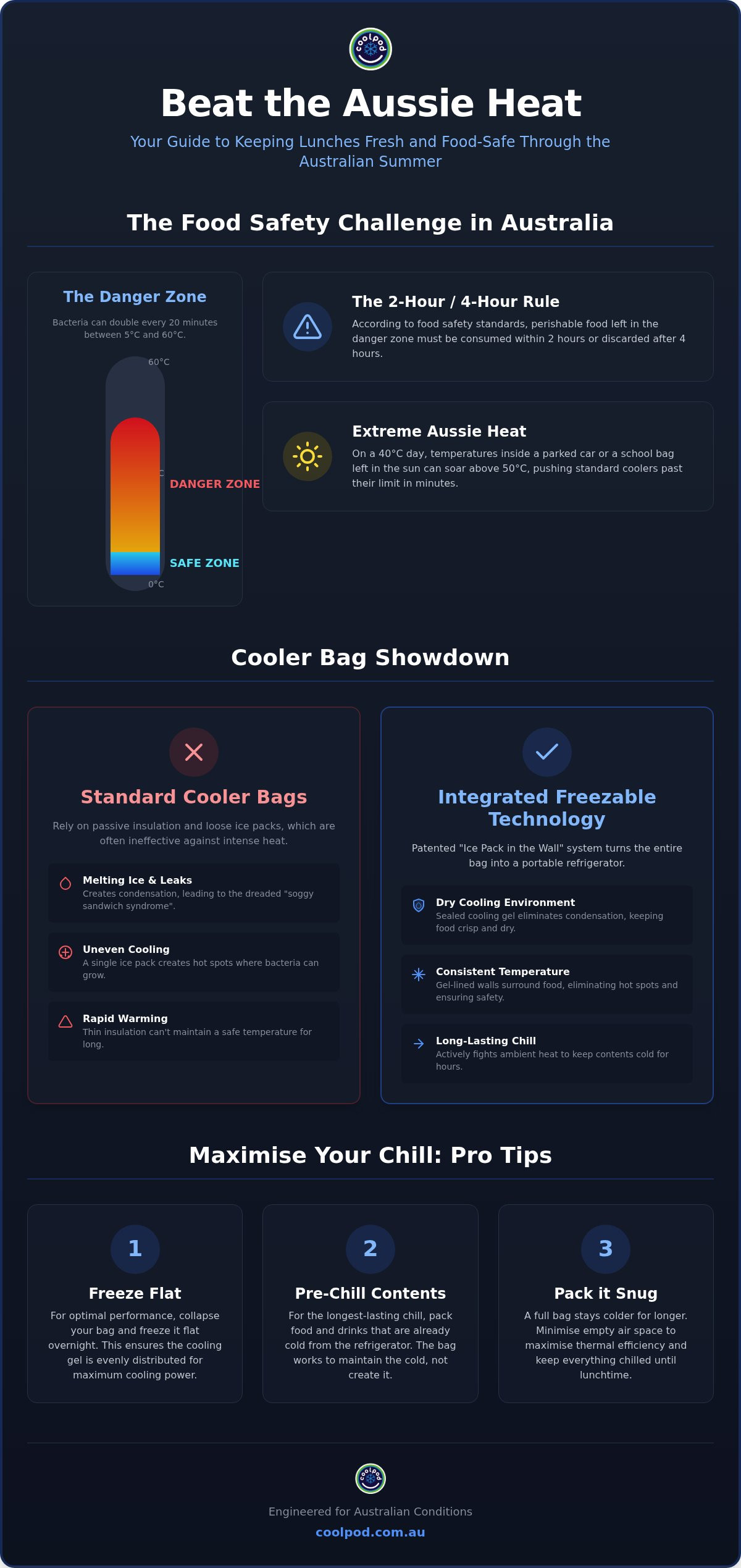
Food safety is a non-negotiable science, especially when dealing with the "danger zone" between 5°C and 60°C. In this range, bacteria can thrive and multiply rapidly, potentially doubling their numbers every twenty minutes. Health authorities often cite the 2-hour/4-hour rule: perishable food is generally safe for two hours outside of refrigeration, but if it spends four hours in the danger zone, it must be discarded. This makes keeping dairy, meat, and yoghurt chilled a critical priority for every family. To ensure safety, school lunches containing perishable items must be kept at or below 5°C until the moment they are consumed at the lunch bell.
By choosing a bag designed for these specific conditions, you eliminate the guesswork. You can pack your lunch in the morning with the confidence that it will still be fresh, crisp, and safe to eat by 1:00 PM, regardless of how high the mercury climbs.
The Science of Sub-Zero: How Patented Freezable Technology Outperforms Standard Bags
While standard bags rely on thick walls to block heat, the Coolpod approach uses an "Ice Pack in the Wall" system. This patented design integrates cooling gel directly into the fabric, turning the entire portable food cooler bag into a functional, mobile refrigerator. By surrounding your food with cooling agents on all sides, you achieve far more efficient heat transfer than you would with a single loose ice pack tossed in the bottom. This ensures that every corner of your lunch stays at a consistent temperature, preventing the "hot spots" that often lead to spoilage.
Engineering a bag that performs this well without becoming a heavy burden requires clever material choices. We've balanced high-performance insulation with lightweight fabrics, ensuring the bag is comfortable for a child to carry in their backpack all day. Durability is equally vital; our materials are selected to resist punctures and prevent gel leaks, ensuring your investment lasts for many summers to come. It’s about creating a smarter way to handle daily routines without adding unnecessary bulk to your commute.
Eliminating the "Soggy Sandwich" Syndrome
Traditional ice packs are notorious for creating condensation as they melt. This moisture inevitably seeps into your bread or crackers, resulting in a wet, unappetising mess. Because our cooling gel is sealed within the walls, it creates a dry, chilled environment. This is especially beneficial for bento-style lunches where multiple compartments need to stay fresh without getting damp. If you're looking for the perfect fit for your lunchbox, check out The Ultimate Guide to Choosing the Best Bento Cooler Bag in 2026.
Patented Engineering vs. Generic Imitations
It's easy to find cheap imitations, but genuine protection comes from rigorous testing and high standards. Our cooling gels are BPA-free and non-toxic, meeting strict food safety guidelines for total peace of mind. With over 15 years of Aussie R&D, we've perfected the gel formula to stay frozen longer in harsh conditions. When you choose a quality portable food cooler bag, you're investing in a product that has been specifically tuned for our climate. You can browse our range of freezable bags to find a solution that fits your lifestyle perfectly.
Finding Your Ideal Fit: A Guide to Sizes and Styles for Every Aussie Occasion
Selecting the right portable food cooler bag involves more than just picking a colour you like; it requires an honest assessment of your daily volume. Whether you need a snack-sized pouch for a quick commute or a full-day meal kit for a double shift on-site, the size of the bag directly impacts its thermal performance. A snug fit is your best friend here. Excess air space inside a bag acts as a thermal bridge, allowing the internal temperature to rise much faster than it would in a tightly packed environment. Understanding the science behind modern coolers helps explain why reducing this air-to-surface-area ratio is the most effective way to maintain a deep chill.
Style also plays a significant role in your choice. A rugged design built for a dusty job site needs to prioritise puncture resistance and heavy-duty zips, while an office-bound professional might value a slim profile that fits into a laptop bag. Specialty cooling is another factor to consider. Some items, like yoghurt or wine, benefit from their own dedicated portable bag to ensure they stay at the optimal temperature without being affected by the rest of your lunch.
For the Daily Commuter and Office Professional
Modern professionals are increasingly moving away from bulky, traditional coolers in favour of slimline designs. The "Adult Lunch Bag" trend has seen a shift toward sleek, mature aesthetics that look right at home in a professional environment. These bags are designed to slide easily into a backpack or briefcase without creating extra bulk. If your day often transitions from the office to an evening social event, you might find that a Lunch Cooler Bag specifically designed for beverages is the perfect companion to keep your drinks crisp until the first pour.
For the School Run and Little Legends
Durability is the primary requirement for any bag destined for the school playground. It needs to survive being tossed into a bag rack and withstand the general rough-and-tumble of a student's day. Easy-to-clean surfaces are essential for handling the inevitable spills and crumbs. For parents looking to keep snacks healthy and safe, the reusable yoghurt pouch australia families trust is a game-changer. It provides targeted cooling for dairy snacks without taking up valuable space in a larger lunch box.
Weekend Adventures and Social Gatherings
When the weekend arrives, your cooling needs often shift toward social sharing. Keeping a Pinot Gris at the perfect temperature at a summer picnic is much easier with a dedicated freezable wine cooler. For larger gatherings, we recommend combining multiple smaller coolers to organise your spread by temperature needs. For more tips on perfecting your outdoor dining setup, check out our Ultimate Guide to Picnic Cooler Bags in Australia 2026. This modular approach ensures your meat, dairy, and beverages stay fresh and safe for the duration of the event.
Maximising the Frost: How to Pack and Care for Your Cooler for Long-Lasting Chill
Getting the best performance out of your portable food cooler bag requires more than just a quick stint in the freezer. To achieve that 1:00 PM crispness we've discussed, you need to follow the "Freeze-Flat" rule. By laying your bag completely flat in the freezer, you ensure the internal cooling gel distributes evenly across all panels rather than pooling in one corner. If the gel bunches up, you create thermal gaps where heat can penetrate more easily, leading to uneven chilling and potential food safety risks. This simple preparation ensures every square centimetre of your lunch is protected by a solid wall of ice.
Pre-chilling your food is another non-negotiable step for the savvy Aussie packer. Placing warm leftovers or room-temperature snacks into a cold bag forces the internal gel to work overtime just to lower the food's temperature. This effectively wastes the bag's cooling energy before your day has even truly begun. Instead, ensure everything is already fridge-cold before it hits the bag. Once you're out and about, adopt the "Zip-it-Quick" habit. Minimising the time the bag stays open prevents the dense, cold air from "pouring" out and being replaced by the sweltering 40-degree air outside.
The Overnight Freeze Routine
Freezers aren't uniform in temperature; the areas near the door are often several degrees warmer due to frequent opening. For maximum chill, place your bag at the back or bottom of the freezer where the air is coldest. For the best results, we recommend a 12-hour freeze to ensure the internal gel is completely solid and ready for the Aussie heat. This overnight routine guarantees that the patented technology is fully charged and ready to fight the morning sun, providing a reliable cooling source that lasts until your final break.
Maintenance and Longevity
Hygiene is vital for any reusable food container, especially when dairy or meat is involved. While it might be tempting to toss your bag in the washing machine, the mechanical agitation can compromise the seals that hold the cooling gel. We recommend a simple hand-wash with warm, soapy water followed by a thorough rinse. When your bag isn't in use, store it in an open position. This allows the internal fabric to air out, preventing the build-up of moisture that leads to mould and unpleasant odours.
Watch for these signs that your bag might be reaching the end of its lifespan:
- Visible thinning or fraying of the internal lining fabric
- Gel that remains liquid or "slushy" even after a full 12-hour freeze
- Unpleasant odours that persist even after a deep manual clean
The Coolpod Advantage: Why Engineering Matters for Australian Food Safety
Choosing a portable food cooler bag is an investment in your daily health and comfort. While generic options might look similar on a shelf, the engineering behind an Australian-owned specialist brand like Coolpod is what makes the difference when the temperature hits 40 degrees. By integrating the cooling technology into the bag itself, we've removed the need for bulky, separate ice packs that eventually leak and take up valuable space. This design also offers a significant environmental advantage. You're no longer relying on single-use plastic bags for ice or disposing of cheap, broken coolers every season. It's a sustainable, long-term solution for the modern Aussie lifestyle.
When you select a high-performance portable food cooler bag, you're choosing peace of mind for your family. Our materials are food-safe and BPA-free, ensuring that your meals remain untainted by chemicals or moisture. This commitment to quality is what has allowed us to support thousands of professionals, parents, and outdoor workers in maintaining fresh, safe meals regardless of the conditions outside.
Supporting Local Innovation
Our patented design is the result of more than 15 years of Australian-led research and development. We've spent over a decade perfecting the gel formula and bag construction to ensure they withstand the rigours of school bags, job sites, and long commutes. Buying from a local specialist means you're benefiting from products designed specifically for our unique conditions, backed by expert knowledge and dedicated support. For a deeper look at how we compare across different styles, see our Best Freezable Lunch Bags in Australia: 2026 Guide.
The versatility of our range means there's a solution for every member of the family. From the Coolpod Freezable Bento Bag for school kids to the Coolpod Freezable Drink Cooler Bag for those on the move, each product follows the same high standards of safety and performance. This variety allows you to tailor your cooling setup to your specific daily needs.
Your Next Steps to a Cooler Lunch
If you're starting your collection, we recommend choosing a size that fits your most common daily meal container. Many of our customers find great value in having a "spare" bag in the freezer. This allows you to rotate them, ensuring you always have a fully charged bag ready to go, even on back-to-back busy days. Before you make your final choice, use this quick checklist:
- Does the bag use BPA-free and non-toxic materials?
- Is the cooling gel integrated into the walls to save space and weight?
- Is the size a "snug fit" for your lunchbox to minimise air gaps?
- Does the brand have a proven track record in the Australian climate?
Ready to upgrade your lunch experience? You can browse the full range of Coolpod Freezable Bags today and join the community of Aussies who have ditched the melting ice packs for good.
Ready for a Fresher Aussie Summer?
Choosing the right portable food cooler bag is a simple decision that has a massive impact on your daily routine. We've explored how active cooling technology, specifically engineered for the intense Australian sun, outperforms standard insulation by keeping your grub safely below the critical 5°C threshold. By adopting smart habits like the "freeze-flat" rule and ensuring your food is pre-chilled, you can enjoy a crisp, fresh lunch regardless of how high the mercury climbs.
With over 15 years of local expertise and thousands of 5-star reviews from Aussie parents and tradies, our designs are built to handle the unique demands of our rugged climate. You don't have to settle for soggy sandwiches or the heavy, leaking mess of traditional ice packs anymore. It's time to embrace a smarter, lighter way to stay chilled on the go.
Shop the Patented Coolpod Range: No Ice Packs Required and experience the peace of mind that comes with professional-grade engineering. Here's to a summer filled with fresh meals, cold drinks, and plenty of outdoor adventures.
Frequently Asked Questions
How long does a portable food cooler bag stay cold?
A high-quality portable food cooler bag can maintain a food-safe temperature below 5°C for up to 8 hours, depending on the external conditions. Factors such as ambient temperature and how often the bag is opened will influence the duration. To get the best performance in the Australian heat, always ensure the bag is frozen for at least 12 hours and packed with pre-chilled food. This ensures your lunch remains crisp and safe until the afternoon break.
Do I need to put ice packs inside a freezable cooler bag?
No, you don't need to add separate ice packs to a patented freezable bag. The cooling technology is integrated directly into the walls of the bag, which eliminates the need for bulky, leaking external packs. This design creates more space for your food while providing 360-degree cooling coverage. It's a much more efficient way to manage your daily meals, as it reduces weight and prevents the mess associated with traditional melting ice packs.
Are freezable cooler bags safe for kids to take to school?
Yes, freezable cooler bags are specifically designed with safety in mind for school-aged children. The materials used are 100% BPA-free, non-toxic, and food-safe, ensuring no harmful chemicals come into contact with snacks or meals. Because the cooling gel is sealed within the fabric walls, there's no risk of leaks in a school bag. They are durable enough to survive the playground while keeping dairy and meat at safe temperatures throughout the entire day.
Can I put my freezable bag in the washing machine?
You should never put a freezable cooler bag in the washing machine. The mechanical agitation and high-speed spin cycles can damage the internal seals that hold the cooling gel, leading to potential leaks. The best way to maintain hygiene is to hand-wash the bag with warm, soapy water and a soft cloth. Always allow the bag to air dry completely in an open position before placing it back in the freezer for its next use.
What is the best way to keep yoghurt cold in a lunch box?
The most effective way to keep yoghurt cold is to use a dedicated freezable yoghurt pouch or bag. These compact solutions provide targeted cooling that surrounds the yoghurt container, which is much more efficient than placing it in a large, half-empty lunch box. By using a specialised portable food cooler bag for dairy, you ensure the product stays well below the 5°C safety threshold, preventing spoilage and keeping the texture perfect for morning tea.
How do I stop my cooler bag from sweating or leaking?
To prevent your bag from "sweating," ensure it is frozen flat for the full 12-hour duration to achieve a solid freeze. Condensation is usually caused by warm, humid air hitting a cold surface; keeping the bag zipped tight and using moisture-wicking fabrics helps manage this. If you notice a genuine leak, it's usually a sign that the internal lining has been punctured or the gel seals have failed. In these cases, it's time to invest in a replacement.
Will a freezable wine bag fit a standard champagne bottle?
A standard freezable wine cooler is designed to fit most 750ml bottles, including many champagne and sparkling wine shapes. However, some wider vintage-style champagne bottles or magnums may be too bulky for the slimline design. The integrated gel panels are flexible enough to accommodate slightly larger diameters, but for the best thermal contact, a snug fit is preferred. This ensures your celebratory drinks stay at the perfect serving temperature even during a long summer picnic or social gathering.


