

If your lunch bag feels more like a weightlifting session than a meal prep win, you're likely still relying on a cooling method that hasn't evolved in decades. Carrying a heavy bag on your commute is tiring enough without a massive plastic block hogging all the space. It's finally time to ditch the old-school gear and embrace smarter alternatives to bulky ice bricks that don't force you to choose between a cold drink and actual room for your food.
We've all been there: opening a lunch box in the middle of a 30°C Australian summer only to find a lukewarm salad and a sandwich soaked by condensation. It's frustrating when your cooling solution creates more mess than it prevents. You deserve a reliable, lightweight system that keeps perishables safe without the unnecessary weight or the "sweating" that leads to soggy crusts. In this guide, we'll show you how to streamline your daily carry with high-performance cooling technology designed for our unique climate. We will explore the latest in freezable bag designs and slimline gel pouches that offer superior protection, ensuring your lunch stays crisp and fresh from the morning commute until the very last bite.
Key Takeaways
- Learn how to reclaim up to 50% more room in your lunch box by swapping outdated cooling methods for streamlined, space-saving designs.
- Compare the most effective alternatives to bulky ice bricks, from simple DIY solutions to advanced slimline gel sheets that won't weigh down your bag.
- Discover the science of integrated cooling and how patented freezable panels provide a 360-degree "chilly bin" effect for long-lasting freshness.
- Identify the best cooling gear for the Australian heat, ensuring your perishables stay safe and crisp without the mess of condensation.
- Follow a practical two-step process to choose the right freezable bag size and style for your specific daily commute and freezer capacity.
The Hidden Cost of Bulky Ice Bricks: Why They Are Letting You Down
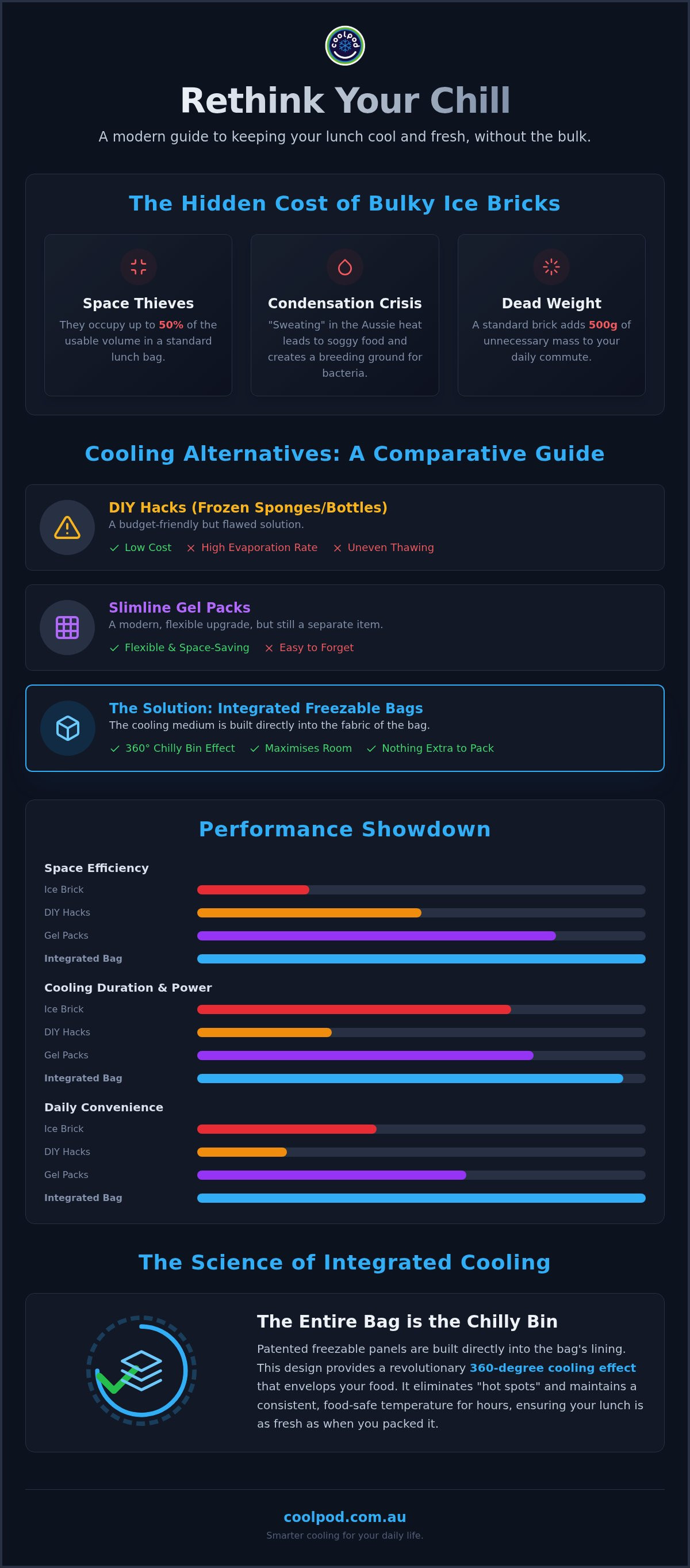
Traditional ice bricks have been a staple for years, but they come with a significant design flaw. They're often "space thieves," occupying up to half the usable volume of a standard insulated bag. If you're trying to pack a healthy bento box or a decent-sized salad, you shouldn't have to sacrifice nutrition just to fit the cooling element. Beyond the space issue, there's the durability factor. Hard plastic casings eventually crack under the stress of repeated freezing and thawing. This often leads to leaking mysterious blue gel onto your food containers, which is a mess nobody wants to clean. Understanding how traditional ice packs work reveals that while they are effective at absorbing heat, their rigid structure is rarely optimised for modern, busy lifestyles. This makes them a clumsy solution for anyone trying to organise a streamlined day.
The Condensation Crisis in the Aussie Summer
Our local climate presents a unique challenge for traditional cooling. In a 30°C+ Australian summer, high humidity levels cause immediate condensation when they strike the freezing surface of a plastic brick. This "sweating" creates a damp environment inside the bag by mid-morning. It's the primary cause of the soggy sandwich syndrome, where moisture seeps into bread, crackers, and even paper bags. This isn't just an appetite killer. A damp, dark interior is the perfect breeding ground for bacteria and mould. Finding better alternatives to bulky ice bricks is about more than just space. It's about maintaining a hygienic, dry environment for your meal so that everything stays as crisp as when you packed it.
Why "Dead Weight" Matters for Your Daily Commute
Carrying unnecessary mass is a physical burden, especially for school children using ergonomic backpacks. A standard 500g ice brick adds considerable weight to a bag already filled with laptops, textbooks, and sports gear. For an office worker on a train or a student walking to school, every gram counts. When you switch to integrated cooling, you remove this external mass entirely. Thermal efficiency in portable cooling is the ability to maintain low temperatures with the least amount of added mass. By choosing smarter alternatives to bulky ice bricks, you reduce the strain on your shoulders while keeping your lunch at a safe temperature. Integrated solutions effectively turn the bag itself into the cooling engine, rather than forcing you to carry a separate, heavy accessory.
Top Alternatives to Bulky Ice Bricks: A Comparative Guide
Finding the right balance between cooling performance and bag space is a daily challenge for many Australians. While the old-school blue block is a familiar sight, it's no longer the only way to keep your ham sandwich safe. Exploring effective alternatives to bulky ice bricks involves looking at everything from simple household hacks to advanced textile engineering. Each option offers a different trade-off between cost, convenience, and how long it can actually withstand the midday sun.
DIY Hacks: Are Frozen Sponges Actually Effective?
Many parents turn to the "sponge hack" as a budget-friendly fix. You simply saturate a clean kitchen sponge, seal it in a reusable silicone bag, and freeze it overnight. It's cheap and fits into tight corners, but it has a high evaporation rate. Once the ice crystals melt, you're left with a damp weight that provides very little thermal protection. Frozen water bottles are another common substitute, often praised for being "dual-purpose." However, they thaw from the outside in, often leaving the core frozen while the surrounding food reaches unsafe temperatures. This is a critical concern when you consider official food safety guidelines regarding perishable items like dairy or cooked meats. DIY methods often lack the consistent thermal mass needed to stay below 5°C for more than a few hours.
Slimline Gel Packs vs. Integrated Technology
Modern innovations like slimline gel sheets and phase-change materials offer a significant upgrade. These alternatives to bulky ice bricks are designed to be flexible, meaning you can drape them over your bento box or wrap them around a yoghurt pouch. They take up far less room, though they still require you to remember to pack them every morning. For busy families, the "forgotten brick" is a frequent cause of wasted food.
Integrated technology solves this by building the cooling medium directly into the fabric of the bag. Using a freezable lunch bag means the entire lining becomes the cooling source. This "zero-brick" approach creates a 360-degree chilly bin effect, surrounding your food with frozen panels that stay cold much longer than a loose gel pack. It's a smarter, more streamlined way to organise your day without the extra weight or the mess of melting ice. If you're ready to simplify your morning routine, you can explore smarter cooling gear designed for the Australian lifestyle.
When comparing these options, consider your typical day. A DIY sponge might work for a quick snack, but a full day at school or a long commute demands something more robust. Integrated solutions offer the highest reliability because they combine insulation and cooling into one single unit, ensuring that nothing is left behind in the freezer when you rush out the door.
The Science of Integrated Cooling: How Freezable Bags Work
Integrated cooling represents a fundamental shift in how we manage portable refrigeration. Unlike traditional setups where you add a cold source to an insulated container, integrated systems merge the insulation and the cooling medium into a single, unified structure. This clever engineering eliminates the need for separate accessories, positioning these bags as the most efficient alternatives to bulky ice bricks currently available. By embedding patented cooling panels directly into the lining, the entire bag becomes an active cooling engine. This technology is particularly suited for the Australian climate, where high ambient temperatures demand a more robust approach to thermal protection than passive insulation can provide.
Thermal Mass and the 360-Degree Cooling Effect
The physics of a standard lunch box often work against the user. Because cold air is denser than warm air, it naturally sinks. When you place a single ice brick at the bottom of a bag, the food sitting on top remains exposed to the warmer air trapped at the top of the container. Integrated cooling solves this by surrounding the contents with frozen walls on all sides. This creates a 360-degree "chilly bin" effect that maintains a uniform internal temperature, regardless of where the food is positioned. A Phase Change Material is a specially formulated substance within these panels that absorbs significant thermal energy as it transitions from a solid to a liquid state, allowing the bag to stay colder for longer periods than standard water-based ice. This consistent thermal mass is what allows a slim bag to outperform much larger, traditional coolers.
Food Safety Standards (FSANZ) and Portable Cooling
Maintaining food safety in the Australian heat is a serious task. According to Food Standards Australia New Zealand (FSANZ), perishable foods must be kept out of the "Danger Zone," which is the temperature range between 5°C and 60°C where bacteria multiply most rapidly. In 30°C+ weather, a passive insulated bag without an active cold source will often reach this zone within an hour. Integrated cooling provides the consistent thermal mass required to keep high-risk items like dairy and meats safe until lunchtime. This level of protection is vital when using a reusable yoghurt pouch australia, as dairy products require steady, low temperatures to prevent spoilage. High-quality outer fabrics further enhance this by providing a moisture-wicking barrier that prevents external humidity from causing condensation on the bag's surface. This dual-action approach ensures your gear remains dry and your food stays safe, making it a superior choice for our demanding local conditions.
How to Choose the Best Alternative for Your Lifestyle
Selecting the right cooling gear depends on your daily rhythm. While we've explored why integrated tech wins on science, the best alternatives to bulky ice bricks for your specific needs will depend on four practical factors. First, assess your capacity. A snack-sized pouch is perfect for a yoghurt, but a full day out requires a bag that can comfortably house a bento box. Second, check your freezer space. Because integrated bags go directly into the freezer, ensure the model you choose can fold flat or fit into your drawer overnight. Third, evaluate the "sweat factor." High-quality outer materials should be moisture-wicking to prevent external condensation from soaking your other belongings. Finally, always prioritise food-safe linings that are 100% BPA and PVC free to keep your meals non-toxic and chemical-free.
The "sweat factor" is particularly important in our humid climate. When cold surfaces meet warm, moist air, they produce condensation. A superior alternative will use technical textiles that act as a barrier, keeping the outside of your bag dry. Checking for non-toxic materials is also a critical safety requirement. High-quality linings ensure that no harmful substances leach into your food containers during the cooling process, giving you peace of mind for both school and work lunches.
Matching the Solution to the Setting
Your environment dictates the level of protection you need. Office workers often prefer slimline designs that slide effortlessly into a professional tote or briefcase without adding unnecessary bulk. For tradies on a job site, ruggedised exteriors are essential to withstand dust and rough handling while providing maximum thermal duration. If you're planning a weekend trip, a picnic cooler bag australia offers the larger capacity needed for family outings while still utilising smarter, integrated cooling panels.
Durability and Maintenance: Making Your Choice Last
To ensure your investment lasts for years, look for high-performance components. Sturdy zips and reinforced handles are non-negotiable in high-use environments like schools or construction sites. Hygiene is also paramount. Wipe-clean internal surfaces allow you to quickly sanitise the bag after each use, preventing any lingering food odours or bacterial buildup. Proper maintenance involves more than just cleaning; you must also ensure the bag is completely dry before storing it. This simple step prevents mould growth and maintains the integrity of the cooling panels. By choosing a well-engineered bag, you're investing in a more efficient way to organise your chilled meals every day.
Ditching the Brick with Coolpod: The Smart Way to Stay Chilled
Coolpod has spent over a decade perfecting a smarter way to handle the daily lunch rush. By integrating cooling panels directly into the bag's structure, we've created the ultimate alternatives to bulky ice bricks that eliminate the need for extra weight and mess. Our range is designed specifically for the demanding Australian climate, ensuring that whether you're at the office or on a job site, your food stays fresh and safe. The "Grab and Go" nature of our design means you'll never have to hunt for loose bricks in the back of the freezer again. You simply fold the bag, freeze it overnight, and it's ready to perform the moment you are. It's a reliable system that removes the guesswork from food safety.
Switching to an integrated system isn't just about saving space; it's about upgrading your entire daily routine. Traditional bricks are clumsy and often left behind on the kitchen bench in the morning rush. With our technology, the cooling source is part of the bag itself, making it impossible to forget. This streamlined approach allows for more room inside the bag for actual food, meaning you can pack that extra piece of fruit or a larger container without struggling to zip the lid shut. We believe in providing a solution that works with your lifestyle, not against it.
The Coolpod Advantage: Patented Innovation
Our journey began with the recognition that traditional cooling methods weren't keeping up with the needs of modern families. As an Australian-owned business, the engineering process behind our patented technology focuses on durability and safety above all else. Every bag uses high-quality, food-safe materials that can withstand the rigours of daily use, from school bag drops to the intense heat of a parked car. For those who value organisation, our bento cooler bag provides the perfect structure for portion-controlled meals while maintaining a 360-degree chill. It's about combining clever design with practical utility to make healthy eating easier for every Aussie family.
From Wine to Yoghurt: A Solution for Every Occasion
The versatility of our range extends far beyond the standard lunch box. We offer specialised solutions like the Coolpod Freezable Wine Cooler for social outings and the Coolpod Freezable Yoghurt Pouch for quick, fresh snacks on the move. This variety allows you to take a "smarter, not harder" approach to your daily food preparation. Beyond the immediate convenience, choosing an integrated system offers significant sustainability benefits. By investing in a durable, reusable solution, you reduce the reliance on single-use ice bags and cheap plastic alternatives that eventually end up in landfill. It's a choice that benefits your daily routine and the environment simultaneously. Explore the full Coolpod range and find your brick-free solution today.
Streamline Your Daily Carry with Smarter Cooling
Transitioning away from outdated cooling methods is the simplest way to improve your daily routine. We've seen how integrated technology provides a 360-degree chill that loose gel packs and DIY hacks simply can't match. By choosing high-performance alternatives to bulky ice bricks, you reclaim valuable space in your bag and eliminate the mess of condensation for good. It's about working smarter to ensure your lunch remains as fresh at midday as it was at 7:00 am.
Australian families have trusted our locally developed innovation since 2010 to handle the toughest conditions. Our designs use 100% food-safe and BPA-free materials, prioritising the health and safety of your loved ones. You don't have to settle for heavy bags and soggy crusts anymore. Upgrade your lunch game with Coolpod’s patented freezable bags and experience the gold standard in portable cooling. It's time to enjoy more room for actual food and a lighter, drier commute every single day.
Frequently Asked Questions
What is the most effective alternative to heavy ice bricks?
Integrated cooling technology is the most effective solution for daily use. Unlike loose gel packs, patented freezable panels are built directly into the bag's lining. This design eliminates the need for separate accessories and provides more room for your food. These alternatives to bulky ice bricks use specialised materials that absorb heat efficiently, making them the smart evolution for anyone looking to streamline their commute while keeping meals fresh in the Australian heat.
Do freezable lunch bags actually stay cold as long as ice packs?
Integrated freezable bags often outperform loose ice packs because they provide a 360-degree cooling effect. Instead of a single cold source at the bottom of the bag, the entire interior surrounds your food with frozen panels. This uniform temperature management keeps perishables safe for hours, even in ambient temperatures reaching 30°C. It's a more reliable way to ensure your lunch stays at a safe, crisp temperature from morning until your midday break.
How do I stop my lunch box from "sweating" and making food soggy?
To prevent condensation, you should switch to a bag with high-quality, moisture-wicking outer fabric. Traditional plastic bricks "sweat" when they hit humid air, but integrated cooling solutions are designed to manage this moisture more effectively. By using a bag with a technical textile barrier, you keep the exterior dry and prevent dampness from seeping into your bread or crackers. This keeps your lunch crisp and your bag hygienic throughout the day.
Can I use a frozen sponge as a safe ice brick alternative?
While a frozen sponge is a cheap DIY hack, it's rarely a safe or robust solution for high-risk foods. Sponges have a high evaporation rate and lose their thermal mass much faster than professional cooling panels. They also pose hygiene risks if they aren't perfectly clean before freezing. For reliable food safety, it's better to invest in purpose-built alternatives to bulky ice bricks that maintain consistent temperatures below 5°C for several hours.
Are integrated freezable bags safe for children to use at school?
Yes, integrated freezable bags are designed with child safety as a top priority. Our range is manufactured using 100% food-safe, BPA-free, and PVC-free materials to ensure no harmful chemicals leach into school lunches. These bags are also engineered for durability, meaning they can withstand being dropped or shoved into lockers. They offer a lightweight, mess-free way for students to carry their meals without the physical strain of heavy plastic bricks.
How long do I need to freeze a Coolpod bag for maximum performance?
For the best results, you should place your bag in the freezer overnight, or for approximately 8 to 12 hours. This ensures the internal cooling panels are completely frozen and ready to provide maximum thermal duration. Because our bags are designed to fold flat, they take up minimal space in your freezer drawer. Simply grab the bag in the morning, pack your food, and you're ready for a full day of reliable cooling.
What is the lightest way to keep a bottle of wine cold for a picnic?
The lightest and most efficient method is using a dedicated freezable wine cooler bag. These specialised bags feature integrated cooling panels that wrap directly around the bottle, removing the need for heavy ice or separate bricks. This design is perfect for picnics or social outings where you want to keep a crisp Chardonnay chilled without lugging around a bulky esky. It's a streamlined, professional solution for keeping beverages at the perfect serving temperature.
Do I still need an insulated bag if I use a freezable alternative?
No, you don't need a separate insulated bag because a freezable alternative is a complete two-in-one solution. The bag itself contains both the high-quality insulation and the integrated cooling panels needed to maintain low temperatures. This "zero-brick" approach simplifies your morning routine and reduces the number of items you need to carry. It's a smarter way to protect your food while maximising the available space inside your lunch box or bento bag.


