

What if the cooling solution you bought to simplify your life is actually adding more stress to your morning routine? Whether you're weighing up the pros and cons of fridge to go vs Coolpod or just looking for a way to keep your yoghurt fresh, the struggle is real when components go missing. You reach into the freezer only to realise a cooling panel has been misplaced by the kids, or worse, you open your bag at midday to find your school books or work documents soaked in condensation.
We agree that a lunch bag should make your day easier, not create more chores. It's frustrating to deal with bulky gear that takes up too much room in the freezer or leaves you reliant on a crowded communal office fridge. In this article, you'll discover why your current freezable cooler might be letting you down and how to choose a smarter, more reliable solution for the Australian heat. We'll look at the benefits of patented integrated cooling technology and provide practical fixes for the most common lunch bag headaches, ensuring your food stays safe and your bag stays dry from the morning rush until the commute home.
Key Takeaways
- Learn why integrated cooling technology eliminates the frustration of lost or forgotten removable panels during the morning school run.
- Understand the design differences of fridge to go vs coolpod, specifically how a one-piece patented system provides more reliable protection in the heat.
- Discover how to reclaim your desk space and avoid office fridge conflicts by using a bag that stays cold for hours without needing a communal chiller.
- Master the simple maintenance steps to prevent internal lining damage and keep your freezable bag hygienic for years of daily use.
- Find out why clever engineering prevents the messy condensation that often ruins school books and work documents in traditional cooler bags.
Common Gripes: Why Traditional Freezable Bags Let You Down
Most Aussies buy a thermal bag to keep their lunch fresh and safe, yet the reality often involves a series of daily frustrations. When you're comparing the design of a fridge to go vs coolpod, you'll quickly notice how much the physical structure impacts your morning routine. Traditional designs frequently rely on removable components that, while functional in theory, often fail to meet the demands of a busy lifestyle.
The Problem with Removable Cooling Panels
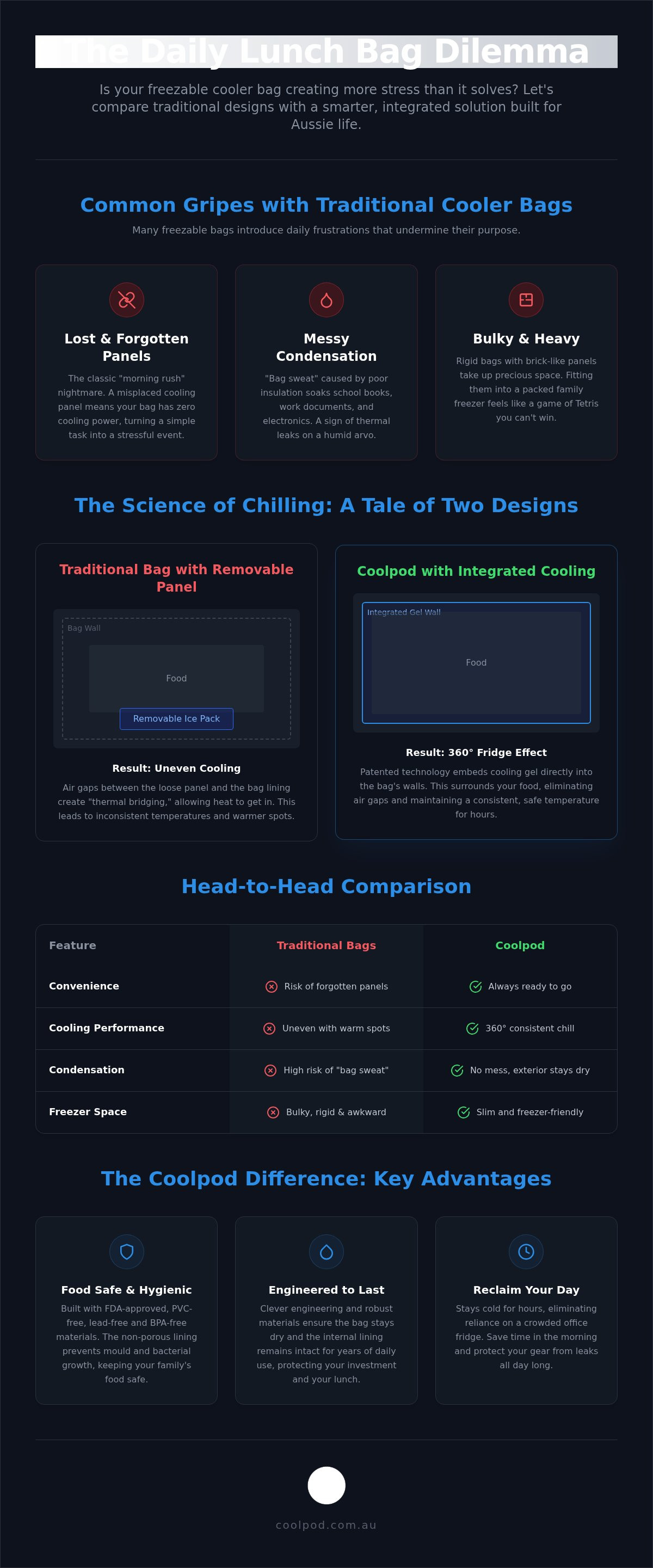
Removable panels are a classic "morning rush" nightmare for parents and professionals alike. These panels often get left on the kitchen bench after a late night wash or tucked away in the back of the freezer where they're easily forgotten. If a panel is missing, the bag loses its primary function and becomes little more than a standard fabric pouch with zero cooling power. It's a stressful discovery to make five minutes before the school bell rings.
There's also a significant technical downside to loose parts. When panels aren't built directly into the lining, air gaps occur between the cooling element and the bag's walls. Thermal bridging happens when heat transfers through these gaps because the loose ice pack isn't making consistent, 360-degree contact with the interior. This leads to uneven cooling, meaning your yoghurt might stay cold while the fruit on the other side of the bag starts to warm up.
Condensation and "Bag Sweat"
On a humid arvo in the Australian heat, poor insulation shows its true colours. Many traditional bags suffer from "bag sweat," where external moisture beads up on the surface and soaks into everything else in the backpack. This condensation is more than just a nuisance; it's a disaster for school books, office documents, and expensive electronic devices. A lunch bag shouldn't require a secondary plastic bag just to keep your laptop dry.
This moisture is usually a sign of a thermal leak. If the outer material of your bag feels cold to the touch or damp, the insulation isn't performing correctly. High-quality designs focus on sealing the cold inside at the zips and seams, ensuring the exterior remains bone-dry even when the mercury rises. You can identify a leak by checking if moisture consistently forms around the zip line or the base of the bag.
Beyond the mess, bulk and weight are persistent issues. Rigid bags or those with heavy, brick-like panels can feel like carrying a literal weight in your backpack. They take up unnecessary volume, leaving less room for your actual lunch. Fitting these cumbersome shapes into a packed family freezer is another hurdle, often requiring a game of Tetris just to get the freezer door shut. A smarter solution needs to be slim enough to slide between the frozen peas and the ice cream without a struggle.
The Science of Chilling: Integrated Tech vs. Removable Parts
When you're deciding between a fridge to go vs coolpod, the real difference lies in the engineering hidden beneath the fabric. Most traditional coolers rely on a separate ice pack that you slide into a pocket. While this seems simple, it creates a fragmented cooling environment. Integrated technology treats the entire bag as a cooling vessel, ensuring that every centimetre of your lunch is protected from the moment it leaves your kitchen.
What is Integrated Cooling Technology?
Integrated cooling is a patented system where the cooling gel is permanently sewn into the walls of the bag. Instead of a single cold brick sitting at the bottom, the gel surrounds your food on all sides. This creates a 360-degree "fridge effect" that maintains a consistent temperature throughout the internal space. It's a smarter way to handle the daily school run because it completely eliminates the "forgotten ice pack" problem. If you've remembered the bag, you've remembered the cooling.
This design is also more energy efficient. Because there are no air gaps between a loose panel and the bag lining, the cold stays trapped exactly where it's needed. This is particularly vital for the Australian climate, where a few minutes in a hot car can cause food temperatures to spike. By using a bag with built-in gel, you ensure a tighter thermal seal that keeps the heat out and the freshness in for hours.
Material Matters: PVC-Free and Food Safe
Safety extends beyond just temperature. For gear that comes into daily contact with your family's food, the quality of the internal lining is paramount. High-quality freezable bags use FDA-approved, lead-free, and BPA-free materials. These linings are specifically engineered to be non-porous, which prevents the mould and bacterial growth often found in cheap, poorly ventilated coolers. Following safe handling recommendations is much easier when your equipment is designed for hygiene from the start.
Durable linings are also essential for storing sensitive items like dairy or yoghurt. Cheaper bags often use thin plastic that cracks after a few months of freezing and thawing, leading to leaks and "gel seepage." Patented designs use reinforced, food-safe fabrics that remain flexible even at sub-zero temperatures. If you're tired of replacing cracked coolers every term, choosing a Coolpod Freezable Lunch Bag provides a long-term solution built for the rigours of the Aussie summer. This focus on premium materials ensures your gear survives the daily commute while keeping your food at a safe, crisp temperature.
Solving the "Office Fridge" Conflict
The communal office fridge is often a battlefield of forgotten leftovers and "fridge hogs" who take up three shelves with a single bulky cooler. In many Australian workplaces, finding space for a healthy lunch is a daily struggle that leads to passive-aggressive notes and lunchtime frustration. This is where the choice between fridge to go vs coolpod becomes a practical lifestyle decision. If your bag can stay cold on your desk all day, you bypass the office politics and the hygiene risks of shared spaces entirely.
Why Your Bag Doesn’t Belong in the Fridge
Most people think putting their insulated bag inside the fridge is a smart move, but the science behind insulation suggests otherwise. Insulated walls are designed to keep heat out, which also means they block the fridge's cold air from reaching your food inside the bag. If you place a sealed, room-temperature bag in a chiller, your lunch might actually stay warmer for longer because the insulation is working against you.
Keeping your food at your desk also offers significant hygiene benefits. Shared fridges are notorious for spills, smells, and cross-contamination. A bag with built-in cooling provides a more reliable, controlled temperature than a fridge that's being opened and closed by dozens of colleagues every hour. It's a cleaner, smarter way to manage your workday nutrition without worrying about whose leaking container is sitting next to your sandwich.
Slimline Alternatives for Busy Professionals
Modern office life requires gear that fits into a professional environment without looking like a camping trip. The Coolpod Freezable Bento Bag is a perfect example of a compact, desk-friendly option that doesn't take up unnecessary room. Its slim profile allows it to sit neatly in a desk drawer or on a corner of your workspace, keeping your meal fresh until midday without needing a communal chiller.
For those who prefer lighter snacks, reusable yoghurt pouches in Australia have become a go-to for saving space in crowded work bags. These pouches and vertical bag designs are engineered to take up minimal volume while providing maximum cooling. By choosing a solution that doesn't rely on the office fridge, you gain independence and ensure your lunch stays at a safe, crisp temperature regardless of how many "fridge hogs" you work with. It's about having a dependable system that works for your schedule, not the office's limited shelf space.
Maintenance Checklist: How to Make Your Cooler Last
Investing in a high-quality freezable bag is the first step toward food safety, but regular upkeep is what ensures your gear survives multiple Australian summers. Whether you've weighed up the differences of a fridge to go vs coolpod or already have a favourite style, the longevity of the internal gel and lining depends on a few simple habits. A well-maintained bag doesn't just stay hygienic; it continues to provide the peak thermal performance you need for those scorching 40-degree days.
The Golden Rules of Freezing
To get the most out of your integrated cooling technology, your freezing technique must be precise. Following these three steps will ensure your lunch stays crisp from the morning commute until your final break of the day.
- Step 1: Dry it out. Always ensure the bag is completely dry before placing it in the freezer. Any residual moisture on the lining can turn into ice buildup, which makes the zips difficult to move and can eventually damage the seams.
- Step 2: Lie it flat. This is non-negotiable. Folds or awkward angles in the freezer cause the cooling gel to pool in one corner. By lying the bag flat, you ensure the gel is distributed evenly across the cooling walls, providing that essential 360-degree protection for your food.
- Step 3: Give it time. For the best results, your bag needs a minimum of 8 hours in the freezer. Most Aussie families find that popping the bag in overnight is the easiest way to ensure it's fully charged and ready for the morning rush.
Cleaning and Odour Control
Daily cleaning is the best way to avoid permanent staining and lingering smells from spicy lunches or tuna salads. After each use, wipe down the internal lining with a damp cloth and a drop of mild dish soap. Avoid harsh chemical sprays or bleach; these can degrade the food-safe lining and eventually break down the patented cooling gel inside the walls. If you're dealing with a stubborn odour, a simple paste of bicarb soda and water left on the lining for ten minutes will neutralise the smell without damaging the fabric.
Deep cleaning requires a gentle touch. You should never put a freezable bag in a washing machine, dryer, or dishwasher. The mechanical agitation and high heat will ruin the insulation and may cause the integrated gel to leak. Instead, hand wash the exterior with a soft brush if it gets dusty or dirty. Always leave the bag open to air-dry completely in a well-ventilated spot before you fold it away or put it back in the freezer. Trapping moisture in the seams is the fastest way to encourage mould growth, which is a headache no one wants to deal with.
Ready to upgrade to a more durable, easy-care lunch solution? Shop the Coolpod Freezable Lunch Bag range and experience the difference of Australian-designed cooling gear built to last.
The Coolpod Difference: Why Our Patented Design Wins
Choosing the right gear for the Aussie summer comes down to reliability and simplicity. When you compare the mechanics of fridge to go vs coolpod, the standout advantage is our "one-piece" design. While other brands rely on components that can be lost, forgotten, or broken, we've spent years perfecting a system that integrates the cooling power directly into the fabric. It's a smarter, more dependable way to handle the daily lunch routine for busy families and professionals.
Why Integrated is Better Than Fridge-to-Go Style Panels
The most significant benefit of integrated technology is the end of the "panel hunt." Traditional bags that use removable chilling panels often leave users frustrated when a part goes missing at school or gets left on the kitchen bench. With our patented system, the cooling gel is permanently sewn into the walls. This creates a consistent thermal barrier that surrounds your food entirely, preventing the "warm spots" that occur when a loose ice pack shifts to one side of a bag.
This design also improves the longevity of the bag. Because the gel is secured within the lining, it doesn't experience the same wear and tear as a panel that is constantly being pulled in and out. This engineering is why we're consistently rated among the best freezable lunch bags in Australia for 2026. You get a streamlined, high-performance cooler that's ready to go as soon as you pull it out of the freezer.
Supporting local experts also makes a difference. Coolpod has been Australian owned and operated since 2010. We understand the specific demands of our climate, from humid northern afternoons to scorching southern heatwaves. This local expertise ensures every product, from our specialised wine coolers to our yoghurt pouches, is built to survive real-world conditions.
Ready for the Job Site or the School Yard
Durability is at the heart of everything we design. Whether it's being tossed into a school locker or sitting on a dusty job site, the outer shell of our bags is engineered to resist daily wear and tear. We use high-quality fabrics that maintain their integrity even after hundreds of freeze-thaw cycles. This ruggedness, combined with our food-safe, PVC-free internal linings, provides peace of mind for parents and workers alike.
The debate over fridge to go vs coolpod ultimately ends with user convenience. A lunch bag shouldn't be a puzzle with multiple pieces; it should be a reliable tool that keeps your food fresh without the fuss. We invite you to explore the full range of Coolpod freezable lunch bags to find the perfect fit for your lifestyle. From compact bento styles to larger drink coolers, our patented technology ensures that your lunch stays at a safe, crisp temperature, no matter how high the mercury rises this summer.
Ready for a Smarter Way to Stay Cool?
Managing the daily lunch rush shouldn't feel like a puzzle. By moving away from traditional bags with loose parts and embracing integrated cooling technology, you eliminate the stress of missing panels and messy condensation. You've learned that a one-piece design provides more consistent protection against the Australian heat and keeps your food safe without needing a crowded office fridge. When you look at the choice between fridge to go vs coolpod, the winner is the system that simplifies your life while delivering superior performance.
We've been Australian owned and operated since 2010, providing families with durable gear made from PVC, lead, and BPA-free materials. Our patented integrated cooling technology ensures your yoghurt, snacks, and meals stay crisp and fresh throughout the day. It's time to reclaim your freezer space and enjoy a lunch bag that actually works as hard as you do.
Ditch the loose ice packs and shop the Coolpod freezable range today for a more reliable, mess-free summer. Here's to fresher lunches and easier mornings!
Frequently Asked Questions
Why does my freezable lunch bag have condensation on the outside?
External condensation, often called "bag sweat," occurs when the cold interior of the bag meets the warm, humid Australian air. If your bag is soaking your backpack, it's usually a sign of poor outer insulation or a thermal leak at the seams. High-quality bags use advanced insulation layers to create a barrier that keeps moisture inside the lining and ensures the exterior remains dry even on humid summer afternoons.
How long do freezable bags actually stay cold in the Australian summer?
Most premium freezable bags are engineered to keep contents at a safe temperature for up to 8 hours. This duration is specifically designed to cover the time from the morning school run until the final lunch bell. To maximise this performance in extreme heat, always pre-chill your food and drinks before placing them in the bag, and ensure the bag has been frozen flat for at least 8 hours overnight.
Can I put my freezable cooler bag in the washing machine?
No, you should never put a freezable bag in a washing machine, dryer, or dishwasher. The mechanical agitation and high temperatures will degrade the patented cooling gel and damage the internal food-safe lining. For the best results and to ensure your gear lasts, simply wipe the interior and exterior with a damp cloth and mild soapy water, then leave it to air-dry completely in a well-ventilated spot.
What is the difference between an insulated bag and a freezable bag?
An insulated bag only uses padding to slow down the transfer of heat, whereas a freezable bag actively chills its contents. When comparing fridge to go vs coolpod, both fall into the freezable category, meaning they function like a portable refrigerator. Unlike standard insulated pouches that require separate ice bricks, these bags have cooling elements built-in or included as panels to provide hours of active refrigeration for your meals.
Are freezable bags safe for yoghurt and dairy products?
Yes, they are highly effective for dairy when used correctly. Because freezable technology provides a consistent "fridge effect," items like yoghurt and cheese stay at a safe, crisp temperature. For smaller snacks, using a specialised Coolpod Freezable Yoghurt Pouch ensures that dairy products don't reach the "danger zone" where bacteria grow, making them a much safer alternative to standard lunch boxes during the warmer months.
My cooling panel is lost; can I buy a replacement or do I need a new bag?
If your bag relies on removable panels and one goes missing, the bag's cooling ability is effectively neutralised. While some brands sell replacement parts, many families find this a recurring frustration. This is why many people prefer integrated cooling where the gel is sewn directly into the walls. With a one-piece system, there are no loose parts to lose, ensuring your bag is always ready for the morning rush.
How do I stop my lunch bag from smelling after use?
Odours are usually caused by trapped moisture or food residue in the seams. To keep your bag fresh, wipe it down daily with a mild soap solution. If a smell persists after a spicy lunch, apply a paste of bicarb soda and water to the lining for ten minutes before rinsing. Always ensure the bag is bone-dry before you put it back in the freezer to prevent bacteria from growing.
Is it better to have a removable ice pack or an integrated cooling bag?
Integrated cooling is generally the superior choice for daily convenience and thermal efficiency. When weighing up fridge to go vs coolpod, the integrated design eliminates the risk of losing panels and provides more even, 360-degree cooling. Because the gel is permanently secured within the lining, it won't shift or create "warm spots," ensuring every part of your lunch stays equally chilled and fresh until you're ready to eat.


