

What if your lunch bag was actually a portable freezer instead of just a fabric box? Most Australians know the mid-day dread of opening a lunchbox at 1:00 pm to find lukewarm ham or a sweating yoghurt pot. We've all struggled with bulky ice packs that leak condensation over everything and take up half the room meant for our actual food. It's a common frustration when you're trying to keep your family's meals safe and fresh in our demanding climate.
If you've ever wondered how do freezable lunch bags work, the answer lies in clever engineering that replaces loose ice with integrated cooling walls. This article explores the science behind phase-change technology and how these smarter bags create a consistent, fridge-like environment. You'll gain the confidence to pack dairy and meat safely, knowing the materials are non-toxic and designed to handle the 2026 Australian sun. We'll show you how to enjoy a mess-free lunch experience while keeping your food at a safe temperature for hours without the bulk of traditional ice bricks.
Key Takeaways
- Understand why maintaining temperatures below 5°C is vital to avoid the bacterial 'Danger Zone' and keep your dairy and meats safe until lunchtime.
- Discover how do freezable lunch bags work by using patented phase-change gel integrated directly into the walls to absorb heat and provide active cooling.
- Learn how to reclaim internal storage space and reduce carry weight by switching from bulky, leaking ice packs to streamlined, built-in cooling technology.
- Master the 12-hour freezing rule and the 'Fridge-to-Bag' pipeline to ensure your meals stay fresh for up to 8 hours, even in the middle of a heatwave.
- Find out why Aussie-engineered designs are specifically built to handle 40°C conditions better than generic insulated imports found in most shops.
The Science of Food Safety: Why Your Lunch Needs More Than Insulation
Packing a lunch in Australia is about more than just choosing the right sandwich fillings. It's a daily battle against the elements, where heat management is key to both food safety and personal well-being. While you're keeping your meals cool, it's also vital to be prepared for other heat-related mishaps like sunburns or scalds, which is where Burn-Fix hydrogel dressings become an essential part of your summer first aid kit. When the mercury climbs, your lunchbox can quickly become a breeding ground for bacteria if it isn't managed correctly. High-protein foods like roast chicken, deli meats, eggs, and dairy are the most at risk. These items are nutrient-rich, which is exactly what pathogens like Salmonella and E. coli need to thrive and multiply.
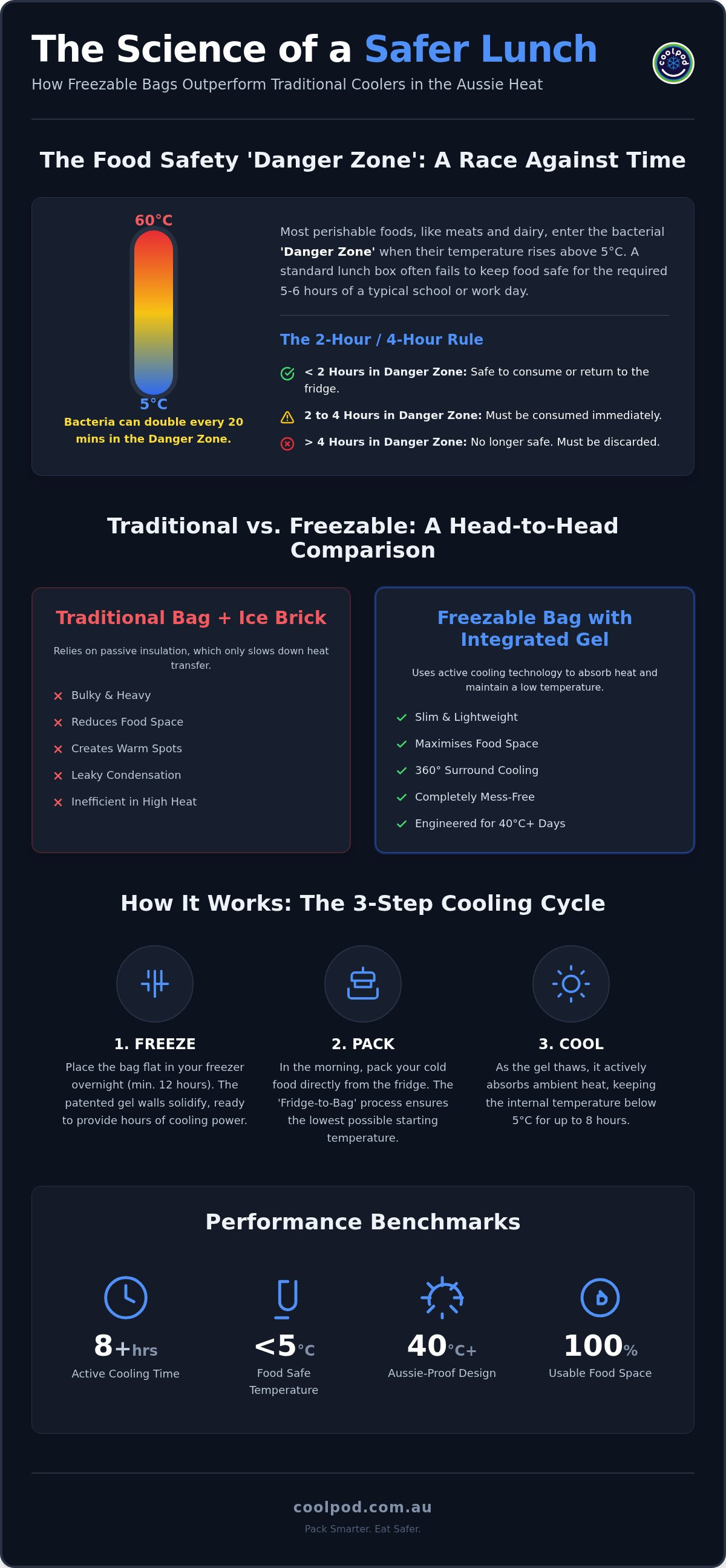
The food safety 'Danger Zone' is the temperature range between 5°C and 60°C where harmful bacteria grow rapidly. In these conditions, bacterial populations can double in as little as twenty minutes. Many people assume that if a yoghurt pot or ham wrap feels slightly chilled, it's safe to eat. However, 'cool to the touch' is a subjective measure that often sits well above the 5°C safety threshold. Once food enters that middle ground, the clock starts ticking on its safety.
Australian food safety authorities recommend the 2-hour/4-hour rule to help families manage this risk. If perishable food has been in the Danger Zone for less than two hours, it's generally safe to eat or refrigerate. Between two and four hours, it should be consumed immediately. Once it hits the four-hour mark, the food is no longer safe and must be discarded. In a typical Aussie school or work day, your lunch needs to stay protected for at least five to six hours, making standard bags insufficient.
How the Australian Heat Accelerates Spoilage
On a typical 35°C day, a standard lunch bag left in a school cubby or a parked car experiences a 'greenhouse effect'. The outer material absorbs solar radiation, trapping heat inside the small internal space and causing temperatures to skyrocket. Humidity also plays a significant role, especially in coastal regions. High moisture levels in the air can actually increase the rate of thermal transfer, meaning your ice bricks melt faster and your food warms up sooner than it would in a dry, inland climate.
Passive Insulation vs. Active Cooling
Most basic lunch boxes rely on passive insulation, which is usually just a thin layer of foam or foil. While this helps slow down the entry of heat, it doesn't actually lower the temperature inside the bag. Eventually, the heat wins. To keep food safe, you need an active cooling system that draws heat away from your food. Understanding how ice packs work is the first step in seeing why thermal mass is vital for long-term chill.
This is where the technology changes the game. When people ask, how do freezable lunch bags work, they're looking for a way to maintain that fridge-like environment without the mess. By integrating cooling gel directly into the walls of the bag, you create a surround-sound cooling effect. For larger outings where you're carrying more than a single meal, using a dedicated picnic cooler bag australia provides the heavy-duty active cooling required to stay below the 5°C limit for the duration of your trip.
How Freezable Bags Work: The Magic of Integrated Gel
Many parents and professionals look at a slim, foldable bag and wonder, how do freezable lunch bags work without a bulky ice brick inside? The secret lies in the walls. Unlike a standard insulated bag where you toss in a separate ice pack, these bags use their entire surface area as a cooling source. By integrating the cooling element directly into the fabric layers, the bag transforms from a simple container into an active cooling system.
This process relies on the physics of latent heat. When you place the bag in your freezer overnight, the gel inside the walls solidifies. As the bag sits in a warm school bag or office, the gel begins to thaw. During this "phase change" from solid to liquid, the gel absorbs a significant amount of heat from its surroundings. It's an active physical reaction that pulls heat away from your sandwiches and snacks, keeping the internal temperature stable for hours. Because the cooling source is built into all four sides, it creates a consistent micro-climate. This eliminates the "warm spots" common with loose ice packs, helping you stay aligned with food safety guidelines that require perishable items to stay below 5°C.
The Role of Phase-Change Materials (PCM)
Standard water-based ice bricks melt quickly and often become rigid and difficult to pack. The specific gel formula used in high-quality freezable bags is a specialised phase-change material. It's engineered to stay frozen longer than plain water while remaining flexible even at sub-zero temperatures. This flexibility is a practical win for busy Aussie kitchens; you can fold the bag flat to save precious freezer space. You can see this technology in action across different styles in our Best Freezable Lunch Bags in Australia: 2026 Guide.
Layer by Layer: The Anatomy of a Coolpod
High-performance cooling requires a sophisticated structure to protect the frozen gel. The design typically consists of three distinct layers:
- The outer layer: Durable, water-resistant fabrics prevent the "sweating" effect. This ensures condensation doesn't soak through the bag and ruin school books or office documents.
- The middle layer: A core of high-density foam acts as a thermal barrier. It shields the frozen gel from the external Australian heat, ensuring the cold is directed inward.
- The inner lining: This food-grade, reflective material works like a mirror. It reflects the cold back into the bag while blocking external heat from penetrating the core.
If you're ready to ditch the bulky ice bricks and upgrade your daily routine, choosing a Coolpod Freezable Lunch Bag is a smarter way to keep your food fresh and safe.
Why Integrated Cooling Beats Traditional Ice Packs
Traditional ice bricks are a bit of a relic. They're bulky, heavy, and always seem to be hidden at the back of the freezer when you're in a rush. When you understand how do freezable lunch bags work, you see that the integrated design solves these daily headaches by turning the container itself into the cooling source. By moving the gel into the walls, you reclaim about 20% to 30% of the internal space that a standard ice brick would usually occupy. This means more room for a larger bento box or an extra snack without needing a larger, more cumbersome bag.
For school children, weight is a significant factor. A standard 500ml ice brick adds half a kilo to a school bag that's already heavy with books and tablets. Integrated bags distribute this weight evenly across the entire structure, making the load much more manageable. You also eliminate the "puddle" problem. Loose ice packs often sweat as they melt, leaving a pool of condensation at the bottom that can turn a sandwich soggy or damage school reports. High-quality freezable bags use moisture-wicking outer layers to keep the exterior dry and your belongings safe. Understanding how do freezable lunch bags work helps you appreciate the 360-degree cooling effect, which provides a consistent chill rather than a single "cold spot" next to a plastic block.
Convenience for the Daily Commute
The morning rush is stressful enough without hunting for loose ice packs. The "Fold and Freeze" method allows you to store the entire bag in the freezer overnight, so it's ready to go the moment you've finished packing. It's a more streamlined system that fits easily into a crowded home freezer. For professionals, carrying a sleek womens lunch bag australia with built-in tech looks much more polished in the office than a bulky esky or a bag with a blue plastic brick rattling around inside.
Durability and Longevity
Cheap plastic ice bags are prone to punctures and leaks, often lasting only a single season before they end up in landfill. Integrated gel is protected by multiple layers of heavy-duty fabric, making it far more resilient for daily use by tradies or busy students. When shopping, look for high-quality zippers with tight teeth; these act as a primary seal to prevent "cold leaks" and keep the internal temperature stable. This all-in-one approach isn't just more convenient; it's a more sustainable, long-term choice for the environment.
Maximising Performance: How to Get 8+ Hours of Cold-Time
To get the absolute best out of your gear, you need to treat the preparation process with as much care as the tech itself. While the integrated gel is powerful, its performance depends on a few simple habits. The gold standard for cooling is the 12-hour overnight freeze. This ensures the gel walls are frozen solid through to the core, providing maximum thermal mass for the day ahead. If you only give it a few hours, the gel might feel cold, but it won't have the "cold reservoir" needed to fight off a 35°C afternoon.
A common mistake is packing room-temperature items. You should always follow the 'Fridge-to-Bag' pipeline. This means ensuring your sandwiches, fruit, and snacks are already at a fridge-safe 4°C before they go into the bag. If you've wondered how do freezable lunch bags work so effectively for some and not others, it often comes down to this starting temperature. The bag's job is to maintain cold, not to chill warm food. Packing a warm drink bottle will actually force the bag to use its energy to cool the drink rather than keeping your meat and dairy safe.
Packing for Success
Thermal mass is your best friend in the heat. A full bag stays cold significantly longer than a half-empty one because there is less air to circulate and warm up. Group your coldest items together in the centre to create a 'cold core'. For an extra boost, using a reusable yoghurt pouch australia that has been frozen can act as an additional internal cooling source. This clever layering helps the bag maintain its internal micro-climate even when the external environment is harsh.
The 'Don't Peek' Rule
Every time you unzip your bag, you let in a rush of warm Australian air. These convection currents quickly displace the chilled air inside, forcing the gel walls to work harder to bring the temperature back down. For tradies on job sites or office workers with multiple snacks, using a bento cooler bag helps you organise snacks separately from your main lunch. This reduces the number of times you need to open the primary compartment, keeping your main meal protected for longer.
Strategic placement is also vital. Always keep your bag in the shade, whether it's under a desk, in a locker, or in the cabin of a truck. To maintain the efficiency of the inner reflective lining, wipe it down with a damp cloth after use to remove any residue. Dust and spills can dull the reflective surface, slightly reducing its ability to bounce cold air back towards your food. If you're ready to see the difference for yourself, browse the full range of Coolpod Freezable Lunch Bags today and upgrade your lunch game.
Why Coolpod is the Smarter Choice for Australian Families
Choosing the right cooling solution is about more than just physics; it's about finding a partner that understands the Australian lifestyle. Coolpod is a proudly Australian-owned specialist, which means our designs aren't just generic imports. They're engineered by people who have lived through 40°C summer scorchers and understand the unique demands of our local climate. When you look at how do freezable lunch bags work, you see that the patented technology we use has set the national standard for reliability and performance in high-heat environments.
Safety is at the heart of every design. We know that when you're packing for your kids, you need to trust the materials as much as the cooling power. Our entire range is BPA-free, lead-free, and PVC-free, using only food-safe, non-toxic gel. This commitment ensures that even if a bag is used every single day for years, it remains a safe environment for your family's meals. We don't cut corners on quality because we know that food safety is a non-negotiable priority for Aussie parents who want to avoid the risks associated with bacterial growth in the heat.
The versatility of our range means there is a solution for every member of the family. From keeping school snacks fresh in a Coolpod Freezable Yoghurt Pouch to ensuring your Friday night drinks stay chilled in our wine cooler bags, we've thought of every scenario. We even offer a Coolpod Freezable Drink Cooler Bag for those long days on the job site where a lukewarm water bottle just won't cut it. Each product uses the same integrated tech to provide a consistent, mess-free chill that lasts throughout the day.
Engineered for the Job Site and the Playground
Australian conditions are tough on gear, requiring a level of durability that standard bags simply don't offer. Our bags feature rugged construction designed to survive being tossed into school lockers or the back of a ute. The 'no-mess' design is a particular favourite for office professionals and parents alike. Because the condensation is managed within the fabric layers, you won't find puddles on your desk or damp school books at the end of the day. Being an Australian-owned brand means we're invested in the quality and durability that local families expect from their daily essentials.
Join the Coolpod Community
Thousands of Aussies have already made the switch to our freezable technology, ditching the bulky, leaking ice bricks of the past. Beyond the convenience, there is a clear economic benefit. By keeping your food at a safe temperature for longer, you significantly reduce food waste and avoid the ongoing cost of disposable ice bags. It's a smarter, more sustainable way to handle your daily meals while supporting local innovation. You're joining a community that values intelligence in design and safety in every bite.
Upgrade your lunch game and shop the Coolpod range today.
Upgrade Your Daily Routine with Smarter Cooling
Mastering the science of food safety in the Australian heat doesn't have to be a struggle. By moving away from passive insulation and embracing active, integrated cooling, you ensure your family's meals stay well below the dangerous 5°C threshold. Understanding how do freezable lunch bags work gives you the confidence to pack dairy and meats safely, knowing that 360-degree phase-change technology is working to protect every bite.
Since 2010, Coolpod has remained a proudly Australian owned and operated specialist. Our patented integrated cooling technology is designed specifically for the unique demands of the Australian climate, offering a durable, mess-free solution that traditional ice bricks simply cannot match. It's a smarter way to manage your daily nutrition while reducing food waste and bulk.
Ready to reclaim your lunchbox space and ditch the melting ice puddles for good? Shop Australia's Best Patented Freezable Lunch Bags and experience the difference of Aussie-engineered performance. Enjoy the peace of mind that comes with a perfectly fresh, safe lunch every single day.
Frequently Asked Questions
How long does a freezable lunch bag stay cold in 30-degree heat?
A Coolpod freezable lunch bag typically keeps your food at a safe temperature for up to 8 hours, even when ambient temperatures reach 30°C. To achieve this duration, you should ensure the bag is kept out of direct sunlight and remains zipped shut whenever possible. For the best results in high heat, always pack items that are already chilled to 4°C directly from your refrigerator before you leave home.
Do I still need to use an ice pack with a freezable bag?
You don't need to use separate ice packs with these bags because the cooling technology is built directly into the fabric walls. When you understand how do freezable lunch bags work, you'll see how the integrated design saves space and reduces weight in your kit. By eliminating loose ice bricks, you have more room for actual food while avoiding the messy condensation that often leaks from traditional plastic ice packs.
Can I put my freezable bag in the freezer every night?
You can absolutely place your freezable bag in the freezer every single night. These products are engineered for daily use and designed to be folded flat to save space in your home freezer. Regular freezing doesn't damage the internal gel or the outer fabric. In fact, keeping the bag in the freezer ensures it's always ready for the morning rush without any extra preparation, making it a reliable part of your routine.
How do I clean my freezable lunch bag without damaging the gel?
To maintain the integrity of the cooling gel, you should only clean your bag using a damp cloth and mild soap. Avoid submerging the bag in water or placing it in a washing machine, as this can damage the internal layers and the reflective lining. Simply wipe down the interior and exterior surfaces after each use and allow the bag to air dry completely before returning it to the freezer for its next cycle.
Is the cooling gel inside the bag safe and non-toxic?
The cooling gel used in every Coolpod product is completely non-toxic and food-safe. We prioritise your family's health by ensuring all materials are BPA-free, lead-free, and phthalate-free. This commitment to safety means you can trust that your dairy, meat, and snacks are protected by high-quality, engineered materials that meet strict standards for daily contact with food and beverages. It provides peace of mind for parents and professionals alike across the country.
Will a freezable bag keep my food from freezing if I pack it too close to the walls?
Your food won't freeze even if it's packed directly against the internal walls. While the gel walls are frozen, they are designed to maintain a consistent fridge-like environment rather than a deep-freeze temperature. This makes them ideal for delicate items like salad leaves or fruit, which stay crisp and fresh without becoming icy or damaged by extreme cold during the day. It's a gentle but effective cooling method for all your favourite snacks.
What is the difference between a freezable bag and a standard insulated bag?
Standard insulated bags are passive barriers that only slow down the warming process using foam layers. In contrast, freezable bags provide active cooling through integrated gel walls that absorb heat. When people ask how do freezable lunch bags work, the difference is the phase-change material that creates a portable refrigerator environment. This active system keeps food safe for hours longer than a basic insulated bag ever could, especially in the demanding Australian climate.
How many hours do I need to freeze the bag for it to work properly?
For the bag to perform at its peak, you should freeze it for at least 12 hours. This overnight duration ensures the patented gel is frozen solid all the way through to the core. If the bag is only in the freezer for a few hours, the cooling effect will be significantly shorter. A full 12-hour freeze is the gold standard for surviving a long Australian school day or a full shift on a job site.


